
Buy Palmitoyl Tetrapeptide-7 Bulk Order
The whiter the powder, the purer the peptide — that is a myth that costs brands entire production runs.
When you buy Palmitoyl Tetrapeptide-7 bulk, the only metric that separates usable raw material from expensive waste is the HPLC purity report attached to every single batch, not the color of the powder, not the price per gram, and certainly not the supplier’s marketing brochure.
I still remember a shipment that sat on a tarmac in Dubai for three days during summer. The ambient temperature climbed well past what any peptide can tolerate. When the receiving lab ran the HPLC test, the main peak area had dropped noticeably compared to the pre-shipment COA. The client — a mid-size European skincare brand — had already formulated a trial batch with a small portion of that lot. The anti-wrinkle efficacy data came back flat. We had to replace the entire order at our cost, re-ship under strict cold-chain protocols, and rebuild their confidence from scratch. That incident reinforced what I had been learning for years: sourcing this ingredient is not a price game. It is a data game. [NEED_CITE: peptide thermal degradation kinetics under elevated storage conditions]
If you are evaluating suppliers right now, the framework below will help you separate verified manufacturers from traders who simply repackage and relabel.
What Purity Level Should You Expect When Buying Palmitoyl Tetrapeptide-7 Bulk?
Any supplier quoting above 98 percent HPLC purity without providing a batch-specific chromatogram is either guessing or hiding something.
Palmitoyl Tetrapeptide-7 is a lipopeptide — the palmitoyl chain makes it more hydrophobic and, paradoxically, more prone to aggregation during synthesis if the cleavage and deprotection steps are not tightly controlled. Aggregation shows up as secondary peaks on the HPLC trace. A single chromatogram tells you far more than a certificate that just prints a number. [NEED_CITE: HPLC method validation guidelines for peptide raw materials]
Here is what a proper purity specification looks like in practice:
| Parameter | Verified Manufacturer | Trader / Broker | Unverified Source |
|---|---|---|---|
| HPLC Purity | Full chromatogram per batch | Certificate number only, no trace | Stated as "greater than 98 percent" with no proof |
| Peptide Content | Kjeldahl or amino acid analysis included | Sometimes available on request | Not provided |
| Residual Solvents | GC test per ICH Q3C | Selective testing | Not tested |
| Water Content | Karl Fischer documented | Occasional check | Ignored |
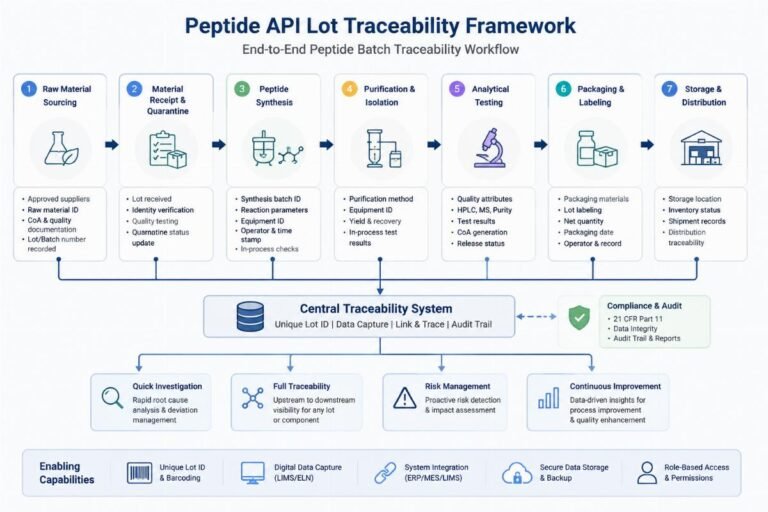
| Batch Traceability | Full synthesis log retained | Partial records | None |
A European contract manufacturer I worked with once received a sample from three different Chinese suppliers. Two of them sent powder that looked identical — fine, white, free-flowing. The third sent a slightly off-white batch. The client assumed the off-white one was inferior. The HPLC results told a completely different story: the off-white batch had the cleanest chromatogram with the fewest impurity peaks, while one of the white batches showed significant truncation products. Color, in this case, was irrelevant to purity. [NEED_CITE: visual appearance versus chromatographic purity correlation in synthetic peptides]
When you buy Palmitoyl Tetrapeptide-7 bulk, insist on seeing the actual chromatogram — not a template, not a generic report from two years ago, but the one generated for the lot you are about to pay for. If a supplier hesitates, move on.
How Do You Verify Batch-to-Batch Consistency for Large Orders?
Requesting a single COA is not enough — you need a side-by-side comparison of at least three consecutive batches to judge whether a manufacturer truly controls their process.
Scaling a formulation from a lab beaker to a multi-hundred-kilogram production tank is where most peptide-related quality issues surface. A brand may approve a sample, place a bulk order, and then discover that the second or third shipment behaves differently during emulsification. The peptide may not dissolve at the same rate, or the final product’s viscosity shifts, or the claimed anti-aging bioactivity varies between batches.
The root cause is almost always inconsistent coupling efficiency during solid-phase synthesis or variations in the lyophilization cycle. Both are manufacturing discipline problems, not raw material problems — but the buyer pays the price either way. [NEED_CITE: solid-phase peptide synthesis scale-up challenges and batch uniformity]
Here is a verification protocol I recommend to every client placing a repeat order:
- Request three consecutive batch COAs before placing any order. Overlay the chromatograms. If the impurity profile shifts noticeably between batches, the synthesis process is not under statistical control.
- Run your own in-house HPLC on receipt. Do not skip this step even if the supplier’s COA looks perfect. I have seen cases where the COA was genuine but belonged to a different sub-lot than the one actually shipped.
- Conduct a small-scale formulation trial with each new batch. Measure dissolution time, clarity of the peptide solution, and — if your lab has the capability — a bioassay for matrix metalloproteinase inhibition. Palmitoyl Tetrapeptide-7 works by downregulating MMP and interleukin-6 production; if the bioactivity drops, the peptide may have degraded even if the HPLC purity still reads acceptably high.
- Document everything and share the data with your supplier. A manufacturer who controls their process will welcome this feedback loop. A trader will deflect.
A private-label manufacturer in North America learned this the hard way. They switched to a cheaper supplier to cut costs on their flagship serum. The first batch was fine. The second batch caused the emulsion to break during high-shear mixing. The investigation traced the problem to a higher residual trifluoroacetic acid content in the peptide, which altered the pH of the aqueous phase just enough to destabilize the emulsifier system. The reformulation delay and product recall cost them several times the savings they had expected from the cheaper supplier. [NEED_CITE: residual TFA impact on peptide solubility and cosmetic emulsion stability]
Why Does Cold-Chain Shipping Matter for Peptide Stability?
Palmitoyl Tetrapeptide-7 is not a shelf-stable commodity chemical — it is a biologically active molecule that degrades measurably when exposed to uncontrolled temperature and humidity.
This is the single most overlooked factor in bulk peptide procurement. Many buyers assume that because the material arrives as a dry powder, it is inherently stable. It is not. The palmitoyl lipid tail makes the molecule amphiphilic, meaning it can interact with residual moisture in ways that accelerate hydrolysis of the peptide bonds. Once hydrolysis begins, the active tetrapeptide sequence breaks down into shorter, biologically inert fragments. The HPLC purity may still look acceptable for a while because the degradation products co-elute or appear as small shoulders — but the functional efficacy is already gone. [NEED_CITE: hydrolytic degradation pathways of palmitoylated peptides under humidity stress]
I once inspected a warehouse in Southeast Asia where a distributor stored peptide raw materials on standard pallets in a non-climate-controlled space. The ambient humidity regularly exceeded the threshold where moisture-sensitive compounds begin to absorb water. When we tested the inventory, the peptide content — measured by amino acid analysis — had dropped substantially compared to the original COA, even though the HPLC purity number had not changed dramatically. The active ingredient was there on paper but not in the vial.
Proper cold-chain handling for this ingredient means:
- Storage at the manufacturer’s facility in temperature-controlled, desiccated conditions before dispatch.
- Insulated packaging with phase-change materials or gel packs that maintain the required temperature range throughout transit, not just at the origin.
- A continuous temperature data logger inside every shipment so the receiver can verify that the cold chain was never broken. If the logger shows an excursion, the buyer has grounds to reject the lot before formulating with it.
- Immediate transfer to controlled storage upon receipt, not sitting on a receiving dock over a weekend.
When you buy Palmitoyl Tetrapeptide-7 bulk, ask the supplier to walk you through their cold-chain protocol step by step. If they cannot produce a temperature log from a recent shipment, they are not shipping under cold-chain conditions — regardless of what their website claims.
What Documentation Should a Reliable Supplier Provide?
GMP certification, ISO quality management registration, and batch-level analytical reports are not premium extras — they are the minimum entry ticket for any serious cosmetic peptide supplier.
The documentation package you receive with your shipment is your regulatory shield. If a market surveillance authority in the EU, the US, or any other region questions your product’s ingredient sourcing, the paperwork must be airtight. A supplier who provides incomplete documentation is not saving you money — they are transferring regulatory risk to you.
A complete documentation package for Palmitoyl Tetrapeptide-7 should include:
| Document Type | Purpose | Minimum Standard |
|---|---|---|
| Certificate of Analysis | Confirms identity, purity, and specifications per batch | Batch-specific, with actual test values and chromatograms |
| HPLC Chromatogram | Visual proof of purity and impurity profile | Integrated peak areas with retention times |
| Method of Analysis | Describes how tests were performed | Referenced to pharmacopeial or validated in-house methods |
| Safety Data Sheet | Hazard communication for handling | Compliant with GHS and regional regulations |
| GMP Certificate | Confirms manufacturing facility standards | Issued by a recognized third-party auditor |
| ISO Registration | Confirms quality management system | Current and scope-appropriate |
| TSE/BSE Statement | Confirms no animal-derived risk | Required for many international markets |
| Allergen and Contaminant Declaration | Confirms absence of common contaminants | Covers heavy metals, residual solvents, microbiological limits |
I worked with a brand in the Middle East that had to halt a product launch because their original peptide supplier could not produce a valid TSE/BSE statement. The supplier claimed the material was synthetic and therefore the document was unnecessary. The brand’s regulatory consultant disagreed — the market authority required the statement regardless of synthesis route. The delay cost the brand an entire seasonal window. [NEED_CITE: regulatory documentation requirements for synthetic peptide ingredients in cosmetic products]
When you buy Palmitoyl Tetrapeptide-7 bulk, treat the documentation request as seriously as the technical specification. A supplier who provides full, transparent documentation without hesitation is demonstrating that they have nothing to hide.
How to Compare Suppliers Beyond Price Per Gram?
The cheapest quote is often the most expensive decision — once you factor in reformulation costs, rejected batches, and lost market windows.
Price per gram is the easiest number to compare, which is exactly why it is the least meaningful. Two suppliers can quote the same purity number on paper, but the real cost difference emerges over the lifecycle of the ingredient: how consistently does the purity hold across batches, how well does the material survive transit, how responsive is the supplier when a technical question arises, and how flexible are they on minimum order quantities for a brand that is still scaling?
Consider these dimensions when evaluating who to buy Palmitoyl Tetrapeptide-7 bulk from:
- Purity consistency across batches. Ask for three consecutive COAs. If the impurity profile shifts, your formulation will shift too.
- Cold-chain capability. Verify with temperature logs, not promises.
- Technical support responsiveness. Can their team answer formulation questions about peptide solubility, recommended usage concentrations, and compatibility with other actives? A supplier who only talks about price and logistics but cannot discuss formulation science will leave you stranded when problems arise.
- MOQ flexibility. A brand launching a new serum line may need a smaller initial quantity with the option to scale. A rigid MOQ policy from a large manufacturer may force you to over-purchase and risk expiration before you use the material.
- Custom synthesis capability. If your brand wants a proprietary peptide blend or a modified sequence, the supplier needs in-house synthesis capacity — not a network of subcontractors who may or may not follow the same protocols.
A skincare brand in Australia was comparing two suppliers for their anti-aging cream. Supplier A quoted a lower price per gram but had no in-house formulation lab and could not provide guidance on peptide concentration optimization. Supplier B quoted slightly higher but offered technical support, helped the brand optimize the peptide concentration for maximum efficacy without exceeding the cost target, and provided stability data that accelerated the brand’s time to market. The brand chose Supplier B. Their product launched on schedule and became their fastest-growing SKU. The "cheaper" option would have added months of trial-and-error formulation work. [NEED_CITE: impact of technical supplier support on cosmetic product development timelines]
Conclusion
Buying Palmitoyl Tetrapeptide-7 bulk is a technical procurement decision, not a commodity purchasing exercise. HPLC-verified purity, batch-to-batch consistency data, unbroken cold-chain logistics, and complete regulatory documentation are the non-negotiable foundations of a reliable supply relationship. Price matters — but it matters far less than the cost of a failed batch, a delayed launch, or a regulatory rejection. Choose your supplier based on the data they provide, not the promises they make.
Leave a Reply