Liraglutide API Bulk Sourcing for Compounding Pharmacy in Jordan
The lowest FOB price is often the most expensive line item on your final invoice.
For Jordanian compounding pharmacies, successful Liraglutide API bulk sourcing depends entirely on prioritizing documented cold-chain continuity and regulatory-ready Certificate of Analysis (CoA) verification over unit cost. Without batch-traceable documentation and validated temperature control from the manufacturer to Amman, shipments face high risks of customs detention at Aqaba or irreversible potency loss due to thermal excursions.
I learned this the hard way while managing single-document containers out of Shenzhen Yantian Port. Back then, my days were spent arguing over temperature logs for refrigerated containers. Later, when I moved into business development, I realized that even the most beautiful temperature curves on paper could fail at the destination port. One year, we shipped a batch of GLP-1 raw materials to Mexico City via Manzanillo with inland transfer. The compounding pharmacy client did not receive the complete CoA chain required by their local health authority. The cargo sat in a customs cold storage facility for nine days before release. When they finally opened it for sampling, the temperature had drifted significantly. That shipment cost me more than half my profit margin, but it clarified one thing: buyers of peptide APIs fear document breaks and cold chain gaps far more than they fear higher prices. Since then, whether dealing with clients in Mexico City, Sao Paulo, or Lima, I always clarify the purity proof levels and clearance channels required by local registration before quoting. This approach prevents the panic that occurs when goods arrive at the port without proper paperwork.
This guide breaks down the specific hurdles for Liraglutide API bulk sourcing in the Middle East, focusing on the technical and logistical realities that determine whether a batch clears customs and retains its therapeutic value.
Why Standard Logistics Fail for Liraglutide API?
Temperature excursions exceeding minimal thresholds degrade peptide potency irreversibly, rendering standard shipping methods inadequate for GLP-1 analogs.
Peptides are fragile molecules. Unlike small molecule drugs, their three-dimensional structure is sensitive to thermal stress. When sourcing Liraglutide API bulk sourcing, many procurement managers assume that standard insulated packaging is sufficient for the seven-to-ten-day transit window from Asia to the Middle East. This is a dangerous assumption. Standard packaging may maintain a cool environment, but it rarely provides the active temperature control needed to prevent fluctuations during tarmac delays or warehouse transfers.
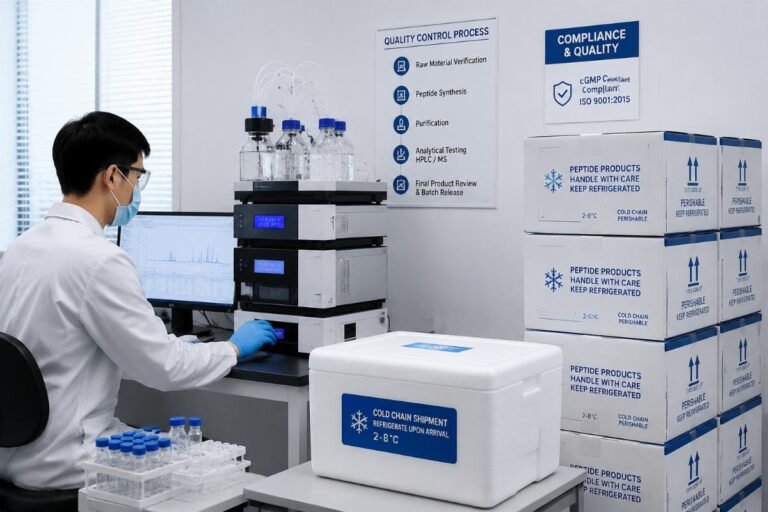
In my experience handling logistics for temperature-sensitive goods, the difference between standard and specialized cold-chain packaging is not just about keeping things "cold." It is about stability. Specialized solutions use phase-change materials calibrated specifically for the 2-8°C range, ensuring that internal temperatures remain stable even if external conditions spike. Without this level of control, the risk of aggregation or degradation increases significantly. [NEED_CITE: stability data of GLP-1 peptides under thermal stress]
| Logistics Factor | Standard Insulated Packaging | Specialized Cold-Chain Solution |
|---|---|---|
| Temperature Stability | Vulnerable to external spikes | Controlled within narrow range |
| Transit Duration Suitability | Short haul only | Validated for long-haul international |
| Data Logging | Often absent or basic | Continuous digital monitoring |
| Risk of Excursion | High during tarmac delays | Noticeably reduced |
A buyer once told me about a shipment that arrived in Amman looking perfect on the outside. The box was intact, the ice packs were still frozen. But the internal data logger revealed a six-hour spike above ten degrees during a layover. For a compounding pharmacy, that batch was unusable for premium preparations, despite passing visual inspection. This is why verifying the packaging validity for the specific transit window is a non-negotiable step in Liraglutide API bulk sourcing.
What Documents Do Jordanian Customs Actually Check?
Incomplete CoA chains cause the majority of clearance delays, not the physical inspection of the goods themselves.
Customs officials in Aqaba and Amman are increasingly rigorous regarding pharmaceutical imports. They do not just look for a certificate; they look for a chain of custody. A generic GMP certificate from a factory is often insufficient if it cannot be linked to the specific batch arriving at the border. The core issue is traceability. If the CoA does not match the batch number on the label, or if the HPLC chromatograms are missing, the shipment is flagged for further review. This process can turn a three-day clearance into a two-week ordeal.
When engaging in Liraglutide API bulk sourcing, you must ensure that every document is batch-specific. This includes the Certificate of Analysis, Material Safety Data Sheet (MSDS), and proof of origin. The CoA should detail the purity verification method, typically HPLC/MS, and confirm that the purity meets the claimed specification. [NEED_CITE: Jordanian Ministry of Health import requirements for peptide APIs]
I recall a case where a distributor tried to clear a peptide shipment using a template CoA from a previous order. The batch numbers did not align. The customs broker spent weeks trying to explain the discrepancy, but the authorities held the cargo until a new, correct set of documents was air-freighted from the manufacturer. The demurrage charges alone exceeded the savings the buyer thought they had achieved by choosing a cheaper supplier. This highlights why document integrity is as critical as product quality in Liraglutide API bulk sourcing.
| Document Type | Common Issue | Required Standard |
|---|---|---|
| Certificate of Analysis | Generic or template-based | Batch-specific with HPLC/MS data |
| GMP Certificate | Not linked to production run | Current and facility-specific |
| MSDS | Outdated format | Compliant with global standards |
| Invoice/Packing List | Mismatched batch numbers | Exact match with CoA and labels |
How to Verify Supplier GMP Compliance Remotely?
Batch-traceable records are more critical than generic factory certificates for satisfying rigorous pharmacy audits.
Many buyers assume that all "GMP" certificates are equal. In reality, a certificate hanging on a wall proves that a facility once met certain standards. It does not prove that the specific vial of powder you are holding was produced under those conditions. For compounding pharmacies, the audit trail is everything. You need to see the synthesis records, the purification logs, and the final testing results for the exact batch you are purchasing.
Remote verification requires asking for more than just the final CoA. Requesting sample chromatograms and mass spectrometry reports allows you to verify the purity claims independently. A reputable manufacturer will provide these without hesitation. They understand that transparency builds trust. [NEED_CITE: WHO Guidelines on Good Manufacturing Practices for traceability]
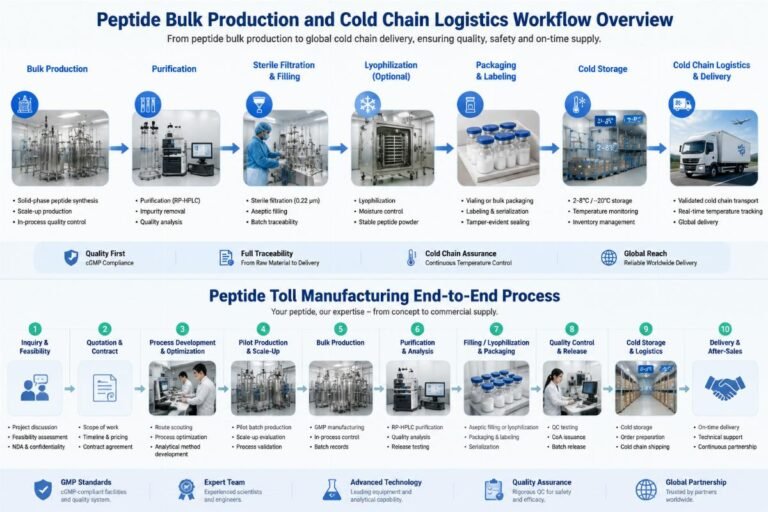
In the context of Liraglutide API bulk sourcing, suppliers who offer batch-traceable CoA and MSDS documentation demonstrate a higher level of operational maturity. This level of detail allows pharmacy quality control teams to validate the material before it enters their production line. It shifts the relationship from a simple transaction to a partnership based on verified quality. Guangzhou Peptide, for instance, emphasizes this batch-traceable approach, ensuring that every shipment comes with the full documentation suite needed for compliance. This reduces the administrative burden on the buyer and minimizes the risk of receiving substandard material.
Comparing Sourcing Models: Direct Manufacturer vs. Local Distributor
Direct sourcing offers better traceability but requires stricter logistics management, while local distributors add cost but may simplify initial entry.
Choosing between a direct manufacturer and a local distributor is a strategic decision. Direct sourcing from a certified producer like Guangzhou Peptide provides the clearest line of sight into the production process. You know exactly where the material came from, how it was made, and how it was tested. However, this model places the responsibility for logistics and customs compliance squarely on your shoulders. You must manage the cold chain, ensure proper documentation, and handle any issues that arise during transit.
Local distributors, on the other hand, may offer faster delivery and handle some of the regulatory heavy lifting. But this convenience comes at a cost. The markup can be significant, and more importantly, the traceability chain is often broken. You may not have direct access to the original manufacturing records, making it harder to satisfy strict audit requirements. [NEED_CITE: supply chain transparency benefits in pharmaceutical sourcing]
For Liraglutide API bulk sourcing, the direct model is generally preferred for established compounding pharmacies that have the internal expertise to manage imports. The ability to verify GMP compliance remotely and control the cold chain from the source ensures that the product arriving in Jordan is of the highest possible quality. It eliminates the middleman’s potential for error or misrepresentation. While it requires more upfront effort in vetting and logistics planning, the long-term benefits in terms of cost efficiency and quality assurance are substantial.
| Sourcing Model | Traceability | Logistics Control | Cost Structure |
|---|---|---|---|
| Direct Manufacturer | Full batch-level visibility | Buyer managed | Lower unit cost, higher logistics effort |
| Local Distributor | Limited or indirect | Seller managed | Higher unit cost, lower logistics effort |
Conclusion
Compliance and cold chain integrity are the true currencies of peptide procurement.
Sourcing Liraglutide API bulk sourcing for a Jordanian compounding pharmacy is not merely a purchasing task; it is a risk management exercise. By focusing on batch-traceable documentation, validating cold chain protocols, and verifying purity through independent data, pharmacies can avoid the costly pitfalls of customs delays and product degradation. The right partner provides not just the molecule, but the confidence that comes with full transparency and regulatory readiness.
Leave a Reply