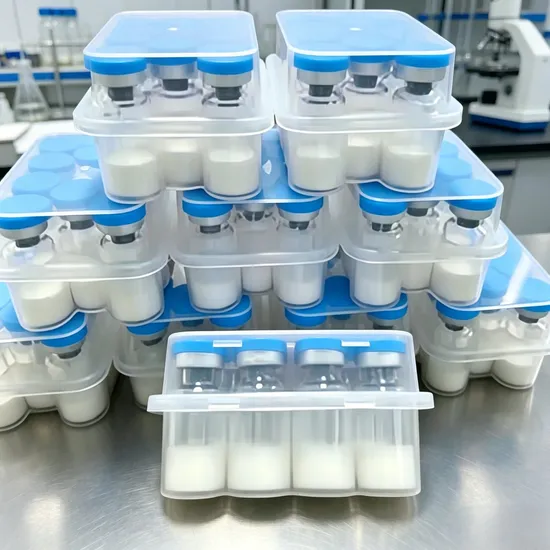
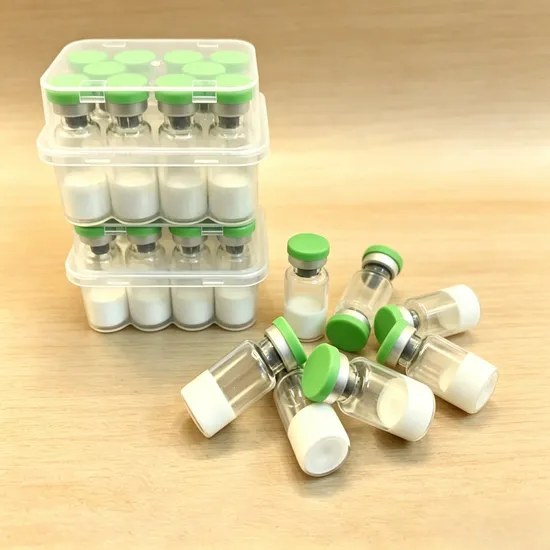
Traceability from synthesis to vial — each lot of GHK-Cu is retained for re-testing and dispute resolution, with the analytical method named on the batch certificate.
Product Specification
| Parameter |
Value |
| Chemical Identity |
GHK-Cu (EINECS 89030-95-5) |
| Product Type |
Peptide Raw Material |
| Appearance |
White lyophilized powder |
| Purity |
99% by HPLC (UV detection at 220 nm, subject to batch certificate confirmation) |
| Endotoxin |
Below 0.1 EU/μg (method to be confirmed on COA) |
| Specification Sizes |
5 mg, 10 mg, 15 mg |
| Storage Temperature |
−20 °C, sealed, light-protected |
| Shelf Life |
24 months (lyophilized, unopened at −20 °C) |
| Reconstituted Stability |
Approximately 1 month at 4 °C; approximately 6 months at −20 °C |
| Reconstitution Solvent |
Sterile water or buffer, 1–10 mg/mL |
| Container Type |
Bottle/Box |
| Testing Methods |
HPLC, MS, NMR (triple testing per batch) |
| Standards |
GMP, USP, EP |
| Origin |
China |
| HS Code |
2937190099 |
Intended Use
| Use Category |
Notes |
| Laboratory research input |
Supplied at research and bulk scale for analytical and molecular studies |
| Peptide signaling research |
High-purity raw material for in vitro model systems |
| Analytical reference material |
Suitable as a laboratory standard when accompanied by batch-specific documentation |
| Synthesis intermediate |
Copper-complexed tripeptide for downstream conjugation or formulation research |
Supplied as a raw material for research and manufacturing use. Not for human or veterinary use. Not a finished product.
Why Two Labs Report Different GHK-Cu Purity on the Same Batch
Method alignment between supplier and buyer laboratories is the single largest variable in purity verification.
When a QC team re-tests a vial of GHK-Cu lyophilized powder and obtains a purity result two percentage points below the certificate of analysis, the discrepancy rarely stems from product degradation. More often it traces back to a different chromatographic column, mobile phase ratio, or detection wavelength. I have seen this exact scenario play out with copper-peptide batches: the supplier ran HPLC on a C18 column with a specific gradient at 220 nm, while the receiving lab used a C8 column and an isocratic method. Both numbers were accurate within their own method, but neither lab initially recognized the methodological gap. [NEED_CITE: HPLC method validation requirements per ICH guidelines]
This is why every GHK-Cu COA we issue names the column model, mobile phase composition, flow rate, and UV detection wavelength used for that specific lot, so the receiving QC laboratory can replicate the conditions before concluding the batch is off-specification.

Method Transparency as the Foundation of Batch Acceptance
GHK-Cu purity HPLC analytical verification only carries weight when the full chromatographic method accompanies the result. A stated value without named parameters leaves the buyer unable to distinguish a genuine out-of-specification batch from a method-mismatch artifact. We provide an analytical method summary alongside every shipment, detailing column chemistry, gradient profile, injection volume, and detection wavelength so that the receiving laboratory has a baseline for alignment.
Triple-Testing Architecture for Identity Confirmation
Purity by HPLC addresses one dimension of quality. Molecular identity requires orthogonal confirmation. Each batch of this copper-complexed tripeptide undergoes mass spectrometry to verify the expected molecular ion, and NMR spectroscopy to confirm structural integrity. This three-method approach catches mislabeling and modification errors that a single analytical technique would miss, reducing the risk of identity-related disputes at the receiving laboratory. [NEED_CITE: orthogonal analytical methods for peptide identity confirmation]
Interpreting Specification Parameters for Downstream Work
The −20 °C storage requirement for the lyophilized powder is not arbitrary; copper-peptide complexes are susceptible to oxidative degradation when exposed to moisture and light over time. Once reconstituted, the solution should be stored at 4 °C for short-term use or returned to −20 °C for extended holding, with attention to freeze-thaw cycles that can promote aggregation. The endotoxin threshold below 0.1 EU/μg matters for laboratories running cell-based assays where endotoxin contamination introduces confounding inflammatory responses. Available specification sizes of 5 mg, 10 mg, and 15 mg allow researchers to match vial quantity to planned usage, reducing the number of times a single container is opened and exposed to ambient humidity. Water content and residual solvent levels, documented on the batch certificate, directly influence accurate gravimetric measurement when preparing stock solutions.
The Cost of Incomplete Documentation at the Point of Receipt
A certificate of analysis that does not name its analytical method is functionally incomplete. When the buyer’s QC team cannot reproduce the stated purity, the dispute enters a cycle of back-and-forth communication that delays research timelines and consumes retained inventory. Similarly, cold chain shipments without temperature logging leave the recipient unable to determine whether transit conditions compromised the lyophilized powder. Import documentation gaps — missing certificates of origin or misclassified HS codes — can hold shipments at customs for days or weeks. [NEED_CITE: customs documentation requirements for peptide raw material import]
Why Procurement Teams Source GHK-Cu from This Facility
Every lot ships with a batch-specific certificate of analysis that names the HPLC column, mobile phase, and detection parameters used for that vial. Custom synthesis to a buyer-supplied sequence and modification is available when catalog specifications do not match the research requirement. Research-scale 5 mg vials and bulk quantities are fulfilled from the same production line, ensuring consistency across scale-up stages. Temperature-controlled packing with transit records accompanies every cold chain shipment, providing verifiable evidence of handling conditions. Import documentation is prepared per destination requirement, reducing customs hold risk. Retained samples from every production batch are held in archive, enabling re-testing if the receiving laboratory’s results require reconciliation.
Documentation & Traceability
- Batch-specific certificate of analysis naming HPLC, MS, and NMR methods used for this lot
- Full chromatograms and mass spectrometry reports provided with each shipment
- Analytical method summary detailing column, mobile phase, and detection wavelength
- Safety data sheet aligned to destination regulatory classification
- Certificate of origin prepared per importing country requirement
- Retained samples archived for future re-testing and specification verification
Storage, Handling & Shipping
- Store lyophilized GHK-Cu at −20 °C in original sealed, light-protected container
- Limit freeze-thaw cycles on reconstituted solutions to preserve complex integrity
- Reconstitute with sterile water or buffer to 1–10 mg/mL under clean bench conditions
- Temperature-controlled packing with transit logging for all outbound cold chain shipments
- HS Code 2937190099 declared on commercial invoice for customs clearance
- Bottle/Box packaging maintained through dispatch to protect against moisture ingress
Requesting a Specification Package for Review
Provide your required specification sizes, target purity threshold, and the analytical method your QC laboratory uses for in-house verification. If your facility requires import documentation beyond standard COA and SDS, specify the destination country and any regulatory paperwork templates your procurement team follows. For custom sequence or modification requests, supply the target structure, scale requirement, and preferred counter-ion form so that feasibility can be confirmed before production begins.
Frequently Asked Questions
Q: How is the stated purity of this GHK-Cu lot determined, and which detection wavelength is used?
A: Purity is determined by HPLC with UV detection at 220 nm, as referenced in our standard method documentation. The exact column model, mobile phase composition, and flow rate are named on each batch-specific certificate of analysis, enabling the receiving QC laboratory to replicate conditions for verification testing.
Q: What documentation accompanies each shipment of GHK-Cu lyophilized powder?
A: Each dispatch includes a batch-specific certificate of analysis, an analytical method summary, HPLC chromatograms, mass spectrometry confirmation, and a safety data sheet. Additional import documents such as certificates of origin are prepared according to the destination country’s regulatory requirements.
Q: How are discrepancies handled when the buyer’s QC re-test result differs from the COA?
A: We first compare the receiving laboratory’s chromatographic method with the method documented on the certificate. If method alignment does not resolve the discrepancy, retained samples from the same batch are re-tested at our facility, and results are shared with full spectral data for joint review.
Q: Are retained samples kept for each production batch, and can they be re-tested?
A: Yes, retained samples from every batch are archived under controlled storage conditions. These can be re-tested upon request to verify ongoing specification compliance or to support dispute resolution when the receiving laboratory reports an out-of-specification result.
Q: What are the storage and shelf life specifications for lyophilized GHK-Cu?
A: The lyophilized powder carries a shelf life of 24 months when stored unopened at −20 °C in sealed, light-protected conditions. Once reconstituted, solutions remain stable for approximately one month at 4 °C or approximately six months when stored at −20 °C.