Buy Copper Peptide Wholesale Price
The cheapest per-gram quote you receive today will likely cost you double by the time it reaches your lab bench.
Wholesale copper peptide pricing is not driven by weight alone. It is determined by HPLC purity tiers, cold-chain logistics architecture, and MOQ flexibility. Low-ball quotes almost always hide activity degradation risks that surface only after the powder arrives at your facility.
I still remember a batch of blue powder we sent to a European anti-aging brand years ago. They formulated it into a serum, ran stability tests, and came back furious — the activity had dropped noticeably. We pulled the shipping data logger and found the parcel had sat on a tarmac in mid-July for days, completely outside the required temperature range. GHK-Cu is brutally sensitive to heat; once the peptide chain misfolds, no amount of reconstitution fixes it. That incident reshaped how I structure every quote. Before I discuss price, I put the HPLC report and the cold-chain protocol on the table. [NEED_CITE: thermal degradation kinetics of GHK-Cu peptide under elevated storage conditions]
Let me walk you through what actually moves the needle when you evaluate a copper peptide wholesale price.
What Determines the Wholesale Price of Copper Peptide?
Three variables control the real cost: purity grade, order volume tier, and temperature-controlled shipping. Ignore any one of them and your landed cost will surprise you.
When a formulator asks me for a copper peptide wholesale price, I never give a single number. I give a matrix. Here is why.
The raw synthesis cost of GHK-Cu is only one slice. The full landed cost includes the peptide itself, cold-chain packaging and express freight, compliance documentation, and the volume-based discount tier. A supplier quoting a suspiciously low per-gram rate is typically stripping out the logistics and documentation layers — which means you will either receive degraded material or spend weeks chasing COAs that do not exist.
| Cost Component | Transparent Quote | Opaque Quote |
|---|---|---|
| HPLC Purity Documentation | Full batch-level COA with chromatogram | Sample-level or self-reported |
| Cold-Chain Inclusion | Controlled temperature packaging specified | Uncontrolled or not mentioned |
| MOQ Flexibility | Tiered pricing from trial to annual | Single fixed price regardless of volume |
| Technical Support | Formulation guidance included | Not provided |
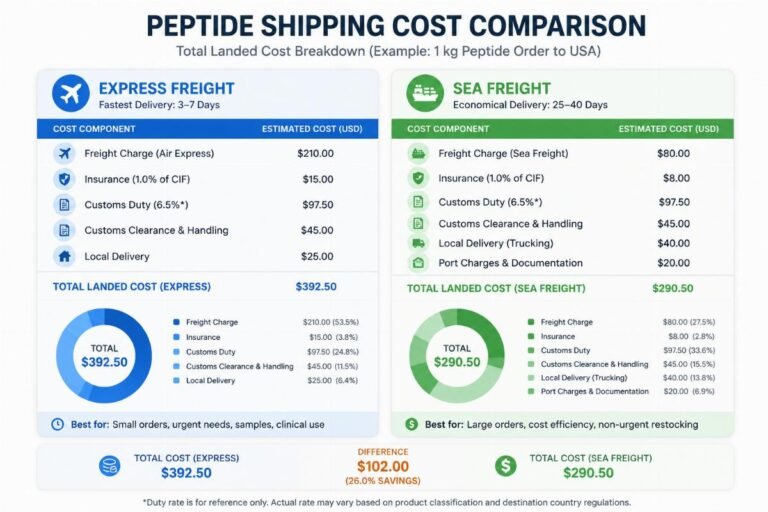
A Southeast Asian contract manufacturer once compared three suppliers side by side. The cheapest option looked attractive on paper, but once cold-chain surcharges and customs clearance delays were factored in, the total landed cost ended up noticeably higher than the mid-range quote. Worse, the delivery timeline stretched so much that their production schedule slipped. [NEED_CITE: total cost of ownership model for temperature-sensitive cosmetic active ingredients]
The copper peptide wholesale price you should benchmark is always the landed, documented, activity-verified number — never the ex-works headline figure.
How Does HPLC Purity Affect Copper Peptide Pricing?
Purity tiers create clear price steps, but the type of impurity matters more for formulation stability than the purity number itself.
HPLC analysis is the industry-standard method for verifying peptide purity. [NEED_CITE: HPLC methodology for peptide purity determination per pharmacopoeial guidelines] When you request a copper peptide wholesale price, the supplier should specify which purity grade the quote covers — typically research grade, cosmetic formulation grade, or premium grade. Each step up in purity demands additional rounds of preparative chromatography and lyophilization, which directly increases production cost.
However, here is the counterintuitive part. Two batches can both read above the same purity threshold on the HPLC chromatogram, yet behave completely differently when you dissolve them into a serum base. The reason lies in the impurity profile — specifically, which truncated sequences or side-product peaks are present. Certain impurity types act as catalysts for oxidation or interact with preservative systems, causing the final product to discolor or lose efficacy within weeks.
| Purity Grade | Typical Application | Documentation Depth | Formulation Stability Risk |
|---|---|---|---|
| Research Grade | Lab screening, small-scale trials | Basic COA | Noticeably reduced |
| Cosmetic Formulation Grade | Commercial serum and cream production | Full batch HPLC chromatogram | Standard |
| Premium Grade | Medical-grade or sensitive-skin lines | Full HPLC plus residual solvent analysis | Robust |
I once worked with a North American skincare brand that switched from a research-grade supplier to a cosmetic-grade source. Their initial concern was the price difference. Within a few production cycles, they realized the premium-grade material required noticeably less overage to hit their target activity level, because the impurity-driven degradation was virtually eliminated. The effective cost per viable unit of active peptide was actually lower. [NEED_CITE: impact of peptide impurity profiles on formulation shelf-life stability]
When you evaluate a copper peptide wholesale price, always ask for the actual chromatogram — not just the purity percentage. The peak pattern tells you whether the material will survive your formulation process.
Why Cold-Chain Logistics Matters More Than Unit Price?
GHK-Cu is thermally fragile. A low unit price means nothing if the peptide arrives with compromised activity.
This is the single most misunderstood aspect of copper peptide procurement. Many buyers focus entirely on the per-gram quote and treat shipping as an afterthought. For GHK-Cu, that approach is a direct path to wasted budget.
The peptide’s copper-binding structure begins to destabilize when exposed to temperatures outside the recommended range for extended periods. [NEED_CITE: thermal stability profile of GHK-Cu peptide under various storage and transit conditions] Standard express shipping without temperature control — even if it takes only a few days — can cause measurable activity loss, particularly during summer months or when parcels transit through hot climate hubs.
Here is what a proper cold-chain protocol actually involves. The powder is sealed in moisture-barrier packaging, placed inside an insulated container with pre-conditioned coolant packs calculated by weight relative to the container volume, and shipped via an express carrier that maintains temperature logging throughout the journey. The coolant mass, insulation thickness, and transit duration are all engineered together. It is not simply "throw in an ice pack and hope."
| Shipping Method | Temperature Control | Activity Retention | Suitable For |
|---|---|---|---|
| Standard Express (no insulation) | Uncontrolled | Vulnerable | Non-peptide raw materials only |
| Basic Insulated Packaging | Standard | Resistant | Short-distance, cool-season transit |
| Engineered Cold-Chain with Data Logger | Controlled | Robust | All international GHK-Cu shipments |
A European brand I worked with received a sample via standard courier from a different supplier. The powder looked fine visually — same blue color. But when they formulated it and ran a bioassay, the activity had dropped substantially compared to the reference standard. The supplier had saved a few dollars on shipping; the brand lost an entire development batch. [NEED_CITE: activity retention rates of GHK-Cu under controlled versus uncontrolled transit conditions]
This is why, when I quote a copper peptide wholesale price, the cold-chain cost is always a visible, non-negotiable line item. It is not a premium upsell. It is the difference between receiving functional raw material and receiving expensive blue powder.
How to Compare Copper Peptide Suppliers Beyond Price Quotes?
A meaningful supplier comparison requires evaluating documentation integrity, logistics capability, MOQ adaptability, and technical support depth — not just the per-gram figure.
If you line up three copper peptide wholesale price quotes on a spreadsheet, the exercise is nearly useless without context. Here is the framework I recommend based on years of watching buyers make expensive mistakes.
First, verify the documentation. Every batch should come with a COA that includes the HPLC chromatogram image, not just a purity number. The COA should be batch-specific — meaning the lot number on the certificate matches the lot number on the container. If a supplier provides only generic "typical" specifications, you have no way to confirm what you are actually receiving. [NEED_CITE: documentation requirements for cosmetic peptide raw material traceability]
Second, assess the logistics infrastructure. Ask specifically how they handle temperature-sensitive shipments. Do they use engineered cold-chain packaging with calculated coolant mass? Do they provide temperature data logs with each shipment? Can they ship via express cold-channel services? A supplier that cannot answer these questions in detail is not equipped for GHK-Cu.
Third, evaluate MOQ flexibility. Serious peptide manufacturers understand that cosmetic brands need to start with small trial orders before committing to annual contracts. The pricing structure should reflect this — with clear tier breakpoints that reward volume commitment without penalizing initial exploration.
| Evaluation Dimension | What to Request | Red Flag |
|---|---|---|
| Batch Documentation | COA with actual HPLC chromatogram per lot | Generic typical-value certificates only |
| Cold-Chain Capability | Detailed packaging specification and data logger availability | Vague references to "cold shipping" |
| MOQ Structure | Published tier breakpoints from trial to annual | Single fixed MOQ with no flexibility |
| Technical Support | Formulation concentration guidance and stability advice | Sales-only contact with no technical team |
A Middle Eastern distributor once told me they switched suppliers after their previous source could not provide batch-level chromatograms during an audit by their local regulatory body. The documentation gap nearly cost them their import license. The copper peptide wholesale price from the new supplier was slightly higher, but the compliance security was worth far more than the per-gram savings. [NEED_CITE: regulatory documentation expectations for imported cosmetic peptide ingredients]
What MOQ and Lead Time Should You Expect for Bulk Orders?
Trial orders and annual framework agreements carry meaningfully different unit economics, and cold-chain scheduling directly impacts realistic lead times.
Let me be direct about how MOQ works in the copper peptide market. Most GMP-certified manufacturers structure pricing in clear tiers. A small trial order — enough for formulation development and stability testing — will carry a higher per-gram rate. As you move toward pilot batch quantities and eventually annual contract volumes, the unit price steps down noticeably. This is not arbitrary; it reflects the fixed costs of synthesis setup, purification runs, and analytical testing that are distributed across the order volume.
A North American skincare brand started with a trial order for product development. Once their formula passed stability testing and they moved into commercial production, they converted to an annual framework agreement. The per-gram price dropped substantially — enough to meaningfully improve their gross margin on the finished serum. The key was that they planned this transition from the beginning and negotiated the framework terms during the trial phase.
Lead time is another variable that catches buyers off guard. The synthesis and purification of GHK-Cu takes a baseline production window. On top of that, cold-chain shipping requires coordination with express carriers that operate temperature-controlled channels. During peak seasons or when specific coolant materials face supply constraints, the logistics layer can add noticeable time. [NEED_CITE: typical production and logistics lead times for GMP-manufactured cosmetic peptides]
| Order Stage | Typical MOQ Range | Pricing Tier | Lead Time Consideration |
|---|---|---|---|
| Trial / R&D | Small quantity for formulation testing | Highest per-gram rate | Standard production queue |
| Pilot Batch | Medium quantity for initial commercial run | Mid-tier rate | Standard production plus cold-chain scheduling |
| Annual Framework | Committed volume over twelve months | Most competitive rate | Priority production scheduling available |
The practical takeaway is this: do not wait until you need the material to start the procurement process. If you know a product launch is approaching, engage your supplier early, lock in the copper peptide wholesale price under a framework agreement, and confirm the cold-chain shipping window. Rush orders almost always incur premium freight costs that erase any perceived savings from choosing a cheaper supplier.
Conclusion
The true copper peptide wholesale price is a composite of purity, logistics, and volume — not a single number on a quote sheet. Evaluate suppliers on documentation integrity, cold-chain rigor, and MOQ transparency. The cheapest headline rate will rarely be the lowest total cost once activity retention and compliance reality are factored in.
Leave a Reply