Buy Peptide Powder Factory Direct from GMP Manufacturer
The lowest per-gram quote on your spreadsheet is almost never the real cost of peptide procurement.
Buying peptide powder factory direct from a GMP-certified manufacturer requires verifying batch-level HPLC purity reports, confirming cold-chain integrity with data loggers, and ensuring COA documentation travels with every shipment—not simply comparing unit pricing across supplier websites.
I still remember the pallet sitting on the warehouse dock in Guangzhou, waiting to be loaded for a European skincare brand. The Argireline powder inside looked pristine—white, crystalline, sealed in foil-lined drums. But the HPLC report from the receiving lab came back showing a purity shortfall that triggered a full return. The root cause was not the synthesis itself; it was a temperature excursion during the last leg of transit. The peptide had absorbed moisture and begun degrading before it ever reached the formulator’s bench. That single shipment taught me more about supply chain accountability than any trade show brochure ever could. When you buy peptide powder factory direct, you are not just purchasing a chemical compound—you are purchasing a chain of custody that must remain unbroken from the reactor vessel to your formulation tank [NEED_CITE: peptide stability degradation mechanisms under humidity exposure per ICH Q1A guidelines].
If you are a cosmetic brand formulator, a private-label manufacturer, or a raw material distributor evaluating direct sourcing from China, the rest of this guide breaks down exactly what to verify before you place a bulk order.
What Certifications Should a Peptide Powder Factory Have?
GMP certification combined with ISO standards and batch-level COA documentation is the baseline operating requirement, not a premium differentiator.
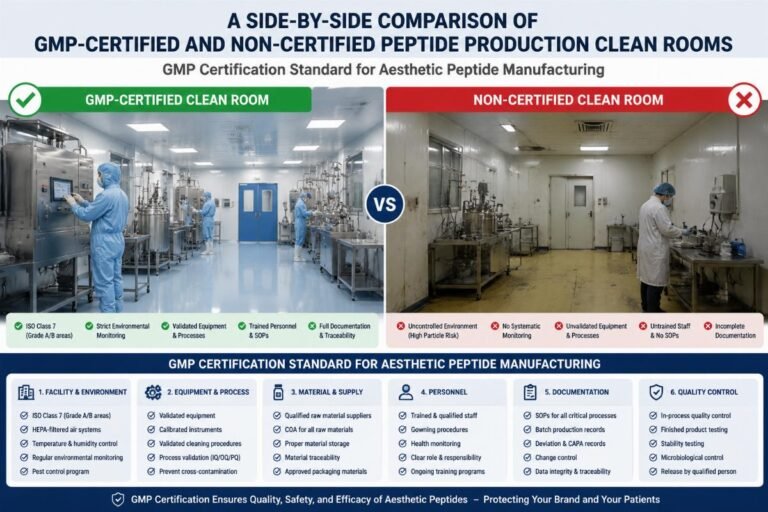
When I first started sourcing peptide actives for overseas clients, I encountered factories that could show you a GMP certificate framed on the wall but could not produce a single HPLC chromatogram for the batch sitting in their warehouse. Certification without traceability is essentially decorative. The certifications that actually matter fall into three tiers:
| Certification Tier | Scope Coverage | Documentation Depth | Buyer Risk if Absent |
|---|---|---|---|
| GMP + ISO Certified | Full production facility audit | Batch-level COA with HPLC chromatograms | Regulatory rejection at customs |
| ISO Only | Quality management system | Sample-level testing reports | Inconsistent batch quality |
| None / Self-Declared | Unverified | Not provided | Entire shipment untraceable |
A GMP-certified peptide manufacturing facility in China must maintain controlled environments for synthesis, purification, lyophilization, and packaging. The cleanroom classification, equipment calibration logs, and raw material traceability records are all subject to audit [NEED_CITE: WHO GMP guidelines for pharmaceutical peptide manufacturing facility requirements]. When a European distributor I worked with evaluated multiple Chinese peptide sources, the factories that could produce ISO 9001 alongside GMP compliance documentation consistently passed the first-round vendor qualification—while those offering only self-declared quality statements were eliminated immediately.
The COA is where many buyers get misled. A certificate of analysis should not be a generic template printed once and reused across shipments. Every batch of peptide powder—whether it is Acetyl Hexapeptide-8, Palmitoyl Pentapeptide-4, or Copper Peptide GHK-Cu—must ship with its own COA reflecting the actual HPLC purity result, residual solvent levels, moisture content, and peptide content by amino acid analysis for that specific lot [NEED_CITE: USP peptide characterization and analytical testing methodology]. If a factory cannot commit to issuing batch-specific COAs that travel with the goods, walk away.
How to Verify Peptide Purity Before Placing a Bulk Order?
Request pre-shipment HPLC reports from the factory and cross-validate with an independent third-party laboratory before releasing payment.
Purity verification is the single most consequential step in the entire procurement process. The difference between a peptide listed at >98% purity and one verified at >99% purity is not a marginal specification detail—it determines whether your finished serum remains stable on the shelf for its intended lifespan or begins forming degradation byproducts within weeks [NEED_CITE: HPLC purity threshold requirements for cosmetic peptide active ingredients].
Here is the verification workflow I follow with every bulk order:
- Request the factory’s in-house HPLC chromatogram for the specific batch, not a representative sample from a previous lot. The chromatogram should show retention time, peak area percentage, and any identified impurity peaks.
- Confirm the testing method—reverse-phase HPLC with C18 column is the industry standard for peptide purity assessment. Ask which mobile phase system and detection wavelength were used.
- Send an independent sample to a third-party testing laboratory such as SGS, Eurofins, or an accredited regional lab. The cost is negligible compared to the risk of receiving a degraded batch.
- Cross-check peptide content via amino acid analysis to confirm the actual peptide mass matches the labeled quantity—purity percentage alone does not tell you the total active content.
- Verify residual solvent levels against ICH Q3C guidelines, particularly for peptides synthesized using trifluoroacetic acid or acetonitrile-based cleavage protocols.
A private-label manufacturer in North America once placed a large order for a custom peptide blend from a supplier who provided a single HPLC report labeled "representative." When the shipment arrived, independent testing revealed that two of the five peptide components had purity levels substantially below the claimed specification. The supplier had no batch-specific records to reference. The buyer absorbed the full cost of the return and reformulation delay.
When you buy peptide powder factory direct, you have the advantage of requesting production-stage samples and witnessing the testing process—either virtually or through a local agent. Use that advantage.
Factory-Direct vs. Distributor: Which Saves More on Peptide Powder?
Factory-direct sourcing delivers a meaningful per-gram cost advantage, but the buyer assumes responsibility for documentation management and cold-chain verification that a distributor would otherwise handle.
This is where the real economics of peptide procurement come into focus. Distributors add a margin layer—sometimes multiple layers if the supply chain passes through regional agents—yet they also bundle services like documentation preparation, local warehousing, and technical support. The question is whether those bundled services justify the price premium for your specific operation.
| Procurement Model | Per-Gram Cost | Documentation Handling | Cold-Chain Management | Technical Support |
|---|---|---|---|---|
| Factory Direct | Noticeably reduced | Buyer-managed | Buyer-verified | Available with ODM partners |
| Regional Distributor | Standard markup | Distributor-managed | Distributor-managed | Included |
| Multi-Tier Broker | Substantially elevated | Fragmented | Uncontrolled | Minimal |
A cosmetic brand in Southeast Asia was sourcing Matrixyl through a European distributor at a per-gram cost that consumed a significant portion of their raw material budget. After switching to direct procurement from a GMP-certified Chinese manufacturer, their per-gram cost dropped noticeably—enough to reformulate two additional products within the same budget. However, they had to build internal capability for reviewing COAs, managing customs documentation, and coordinating cold-chain logistics. For a company with a dedicated procurement and quality team, this trade-off was entirely worthwhile. For a solo formulator without those resources, the distributor route might still make sense.
The hidden value of factory-direct sourcing lies in ODM and custom synthesis capability. When you work directly with a manufacturer that offers custom peptide synthesis, you can request specific sequence modifications, concentration adjustments, and blend formulations without the communication delays and cost markups that come from passing requests through intermediary channels [NEED_CITE: custom peptide synthesis ODM service capabilities for cosmetic active ingredients]. This is particularly relevant for brands developing proprietary anti-aging complexes or multi-peptide serums.
What MOQ and Lead Time Should Cosmetic Brands Expect?
Flexible MOQ arrangements ranging from gram-scale sampling to kilogram-scale production runs are available from GMP manufacturers, with standard peptide lead times typically measured in days rather than weeks.
One of the persistent misconceptions in peptide sourcing is that factory-direct procurement requires massive minimum orders. This was perhaps true a decade ago when Chinese peptide manufacturers focused almost exclusively on bulk pharmaceutical intermediates. Today, the landscape has shifted considerably to accommodate the needs of cosmetic brands at every stage of development.
The MOQ structure I have observed across multiple GMP-certified peptide manufacturers in China generally follows this pattern:
- Gram-scale orders for sampling, formulation trials, and stability testing are accommodated with minimal friction. This is essential for brands developing new products who need to test multiple peptide combinations before committing to production volumes.
- Hectogram-scale orders for initial commercial production runs of niche or newly launched products.
- Kilogram-scale orders for established products with consistent market demand.
Lead times for standard catalog peptides—such as Argireline, Matrixyl, Snap-8, and Copper Peptide—typically fall within a relatively short window from order confirmation to dispatch, assuming the peptide is in stock or requires only standard synthesis scheduling. Custom synthesis peptides with novel sequences naturally require extended timelines for synthesis, purification, analytical testing, and lyophilization [NEED_CITE: standard peptide synthesis cycle time and ODM production scheduling].
A brand developer in the Middle East was formulating a new hair growth serum and needed to evaluate several peptide actives—including a custom blend—before finalizing the formula. The manufacturer provided gram-scale samples of each component within a short turnaround, allowing the formulator to complete stability testing and finalize the product specification well before the initial commercial production deadline.
The flexibility in MOQ is particularly valuable for private-label manufacturers who produce white-label skincare for multiple brands simultaneously. Being able to order different peptides in varying quantities from a single source simplifies procurement logistics and reduces the administrative burden of managing multiple supplier relationships.
How Does Cold-Chain Shipping Protect Peptide Integrity?
Temperature-controlled logistics with embedded data loggers is the critical safeguard that prevents peptide degradation during international transit—and it is the factor most frequently overlooked by first-time buyers.
Peptide powders are inherently sensitive to moisture and temperature fluctuations. Lyophilized peptides stored under proper conditions—sealed, desiccated, and temperature-controlled—maintain their stability for extended periods. But the moment a shipment leaves the factory and enters the international logistics chain, it is exposed to conditions that can compromise integrity if not properly managed [NEED_CITE: peptide powder storage stability requirements and temperature sensitivity].
The cold-chain process I implement for every international peptide shipment operates as follows:
- Primary packaging: Peptide powder is sealed in foil-lined, nitrogen-flushed vials or drums with desiccant packs to eliminate moisture exposure.
- Secondary packaging: Insulated containers with phase-change material packs maintain the required temperature range throughout transit.
- Temperature data loggers: USB or wireless data loggers are embedded in each shipment to record temperature readings at regular intervals throughout the journey.
- Express courier selection: Temperature-sensitive shipments are routed through DHL, FedEx, or equivalent express services with priority handling to minimize transit duration.
- Data review upon arrival: The buyer downloads the data logger readings immediately upon receipt to confirm that no temperature excursion occurred during transit.
This is the lesson I learned the hard way with that European Argireline return. The peptide left the factory in perfect condition. The HPLC report was clean. But somewhere in the transit chain—likely during a tarmac transfer or in a non-climate-controlled sorting facility—the temperature rose enough to trigger moisture absorption and subsequent degradation. Without a data logger in the shipment, there was no way to prove where the excursion occurred or to hold any party accountable.
Since implementing mandatory data logger inclusion in every cold-chain shipment, I have not had a single purity-related return. The cost of a data logger is trivial compared to the cost of a rejected shipment, and the documentation it provides protects both the buyer and the manufacturer in the event of a dispute.
When you buy peptide powder factory direct, insist on cold-chain shipping with data logging as a non-negotiable requirement. Any manufacturer unwilling to provide this level of shipping integrity assurance is not a manufacturer you should trust with your formulation.
Conclusion
Peptide procurement is a supply chain discipline, not a price comparison exercise.
Buying peptide powder factory direct from a GMP-certified manufacturer offers clear cost and customization advantages, but those advantages only materialize when the buyer actively verifies batch-level purity, demands COA documentation with every shipment, and enforces cold-chain logistics with data logger accountability. The factories that invest in these operational details are the ones worth building long-term sourcing relationships with.
Leave a Reply