
Cosmetic Peptide Supplier for UAE Market: Buyer Guide
Most active cosmetic peptides degrade rapidly at room temperature, and a Certificate of Analysis showing a single purity number tells you almost nothing about what is actually inside the vial.
When sourcing from a cosmetic peptide supplier for the UAE market, buyers must verify three things before placing any order: full HPLC chromatograms with impurity peak disclosure, validated cold-chain shipping with continuous temperature logging, and complete GMP documentation traceable to each batch. Price comparison alone leads to degraded stock, rejected shipments, and reformulation costs that dwarf the original savings.
I still think about a skincare brand in Dubai that ordered a multi-kilogram batch of Argireline powder from us years ago. To cut freight costs, I shipped it at ambient temperature. By the time it cleared customs and reached their lab, potency had dropped noticeably. They rejected the entire batch. That loss was entirely on me. Since then, every peptide leaving our facility in Guangzhou travels with a calibrated temperature logger, and I walk every new UAE buyer through the exact documents they should request before we even discuss pricing. [NEED_CITE: thermal stability profiles of acetyl hexapeptide-8 under ISO storage guidelines]
If you are evaluating a cosmetic peptide supplier for your next formulation, the checklist below reflects what actually separates reliable deliveries from costly rejections.
What Documentation Should UAE Buyers Request from Peptide Suppliers?
A complete documentation package includes a batch-specific COA, raw HPLC chromatogram, MSDS, and a valid GMP or ISO certificate from the cosmetic peptide supplier.
Requesting only a COA is like reading a book summary and assuming you know the plot. The COA is a summary; the chromatogram is the evidence. For UAE importers, customs authorities and downstream brand clients increasingly ask for traceable proof, not just a one-page certificate. [NEED_CITE: UAE Ministry of Health and Prevention import documentation requirements for cosmetic raw materials]
Here is what each document should contain and why it matters:
| Document | Minimum Required Content | What to Watch For |
|---|---|---|
| COA | Batch number, purity, moisture, residual solvents, heavy metals | Must match the exact batch shipped, not a generic template |
| HPLC Chromatogram | Full run with labeled peaks, integration parameters, detection wavelength | Peaks should be annotated; solvent and impurity peaks must be visible |
| MSDS | Handling, storage temperature, first-aid measures, transport classification | Storage section must state the required temperature range |
| GMP/ISO Certificate | Issuing body, scope, expiry date, facility address | Scope must explicitly cover peptide synthesis or cosmetic active manufacturing |
A contract manufacturer in the Middle East once compared COA files from three different sources. Two of them claimed the same purity figure, but when the buyer asked for raw chromatograms, one supplier could not provide them and the other showed unresolved impurity peaks that had clearly been excluded from the reported number. [NEED_CITE: HPLC integration standards per USP general chapter on chromatography]
If a cosmetic peptide supplier hesitates when you ask for raw chromatograms or cannot produce a batch-matched COA within a reasonable timeframe, that is your answer. Move on.
How to Verify Peptide Purity Beyond the COA Number?
Request the original HPLC chromatogram and confirm that solvent peaks and known impurity peaks have been properly excluded from the purity calculation.
A purity number on a COA is only as trustworthy as the method behind it. The standard approach uses a C18 reversed-phase column with a defined mobile phase gradient and UV detection, but the details matter enormously. Two suppliers can both report the same purity figure using completely different integration settings, and the actual chemical content of the powder can differ substantially. [NEED_CITE: reversed-phase HPLC method validation guidelines for peptide purity per EP monographs]
Here is what formulators and QC managers should check on every chromatogram:
- Baseline resolution — peaks should be clearly separated, not merged into broad humps that hide co-eluting impurities.
- Peak annotation — the main peptide peak, acetylation or deamidation variants, and deletion sequences should all be labeled.
- Integration method — confirm whether the supplier integrates from baseline or uses valley-to-valley; this choice directly affects the reported purity.
- Detection wavelength — typically set around the peptide’s UV absorption maximum; an unusual wavelength may indicate the method was not optimized for that specific sequence.
- System suitability — a valid run includes a reference standard injection confirming column performance before the sample.
A private-label skincare formulator in the Gulf region received samples from a cosmetic peptide supplier advertising high purity at a low price. The COA looked clean. But when their in-house lab ran an independent HPLC check, they found multiple unresolved impurity peaks that the original chromatogram had simply not shown. The reformulation delay and wasted base cream stock cost several times the price difference they had hoped to save.
Why Cold-Chain Shipping Is Non-Negotiable for Cosmetic Peptides?
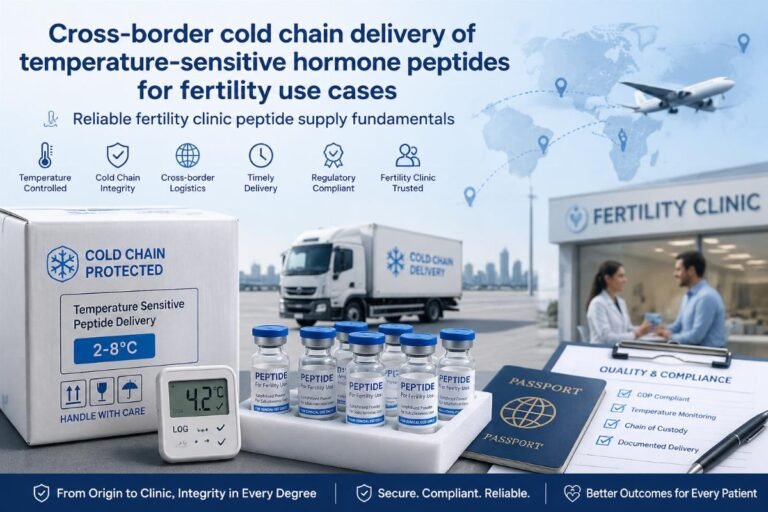
Most cosmetic peptides are thermally sensitive and require continuous temperature-controlled shipping; ambient transport leads to measurable potency loss before the product even reaches the buyer’s lab.
This is the single most misunderstood point in peptide sourcing. Many buyers assume peptide powder is stable at room temperature because it looks like an inert white solid. In reality, sequences like Argireline, Matrixyl, GHK-Cu, and Snap-8 are susceptible to hydrolysis, oxidation, and aggregation when exposed to elevated temperatures, even for short periods. [NEED_CITE: stability data for cosmetic peptides under ICH guidelines]
The correct approach involves three layers:
- Pre-shipment storage at the specified temperature range, verified by the cosmetic peptide supplier’s warehouse logs.
- Insulated packaging with sufficient coolant mass to maintain the required range for the full transit duration, including customs holding time.
- Continuous temperature logging using a calibrated digital data logger that records at regular intervals throughout the journey.
A distributor in the UAE once received a sample shipment via express courier with a temperature logger included. The logger showed the package sat above the recommended threshold for a significant portion of the journey due to tarmac exposure during a layover. Because the logger caught it, the buyer rejected the sample before formulating with it. Without the logger, they would have built an entire pilot batch with compromised active.
| Shipping Factor | Compliant Practice | Common Shortcut |
|---|---|---|
| Packaging | Insulated box with phase-change coolant | Standard cardboard with ice pack |
| Temperature Monitoring | Digital logger with full journey record | No monitoring or sticker indicator only |
| Transit Time | Express courier with priority handling | Economy freight with unknown delays |
| Customs Preparedness | Pre-filed documents for fast clearance | Documents prepared after arrival |
When you contact a cosmetic peptide supplier, ask explicitly how they handle thermal exposure during the last-mile segment in the UAE. The answer will tell you more about their reliability than any marketing claim.
How to Compare UAE Peptide Suppliers: Price vs Reliability?
Build a four-dimensional evaluation matrix covering documentation completeness, batch consistency, cold-chain capability, and technical support — unit price alone is a poor predictor of total cost.
The cheapest cosmetic peptide supplier is rarely the cheapest option once you factor in rejected batches, reformulation labor, delayed product launches, and damaged relationships with your own brand clients. I have seen buyers switch suppliers three times in a single year because they optimized for the invoice line item and ignored everything else.
Here is a practical comparison framework:
| Evaluation Dimension | What to Request | Red Flag |
|---|---|---|
| Documentation Completeness | Batch COA, raw HPLC, MSDS, GMP cert | Generic or template documents |
| Batch Consistency | COA data from three consecutive batches | Inability to provide historical batch data |
| Cold-Chain Capability | Shipping SOP, logger sample data, packaging specs | Ambient shipping offered as default |
| Technical Support | Formulation concentration guidance, solubility data | Sales-only contact with no lab access |
A skincare brand developing an anti-aging serum line in Dubai evaluated multiple sources using this framework. The lowest-priced option failed on documentation and cold-chain capability. The highest-priced European option scored well but had long lead times and rigid minimums. A Chinese manufacturer with GMP-certified facilities, full batch-level documentation, and express cold-chain shipping via international couriers offered the best balance of reliability and lead time for their launch schedule. [NEED_CITE: GMP certification requirements for cosmetic ingredient manufacturers per ISO standards]
The key insight: a cosmetic peptide supplier that invests in documentation rigor and cold-chain infrastructure is signaling that they understand the chemistry, not just the commerce.
What Are the Import Requirements for Cosmetic Peptides in UAE?
Buyers must confirm the exact document set required by Dubai customs for peptide raw materials, ensure GMP certificates are from recognized bodies, and prepare for temperature-sensitive cargo handling at the port of entry.
UAE customs regulations for cosmetic raw materials have tightened in recent years. Peptide powders intended for cosmetic formulation are generally classified under specific HS codes for organic chemical compounds, and the importing entity must hold a valid trade license covering cosmetic or chemical raw material distribution. [NEED_CITE: UAE customs classification and import licensing requirements for cosmetic raw materials]
The standard document set includes:
- Commercial invoice and packing list matching the shipment exactly.
- Certificate of origin, preferably legalized or attested as required.
- COA and MSDS in English, with batch numbers matching the physical shipment.
- GMP or ISO certificate from the manufacturing facility.
- Free sale certificate or manufacturer declaration, depending on the end-use classification.
A distributor importing peptide actives into Dubai for the first time prepared all standard documents but discovered at the last minute that their chosen courier did not have the cold-chain handling capability at the destination warehouse. The shipment sat on the tarmac longer than the coolant could sustain. Switching to a courier with dedicated temperature-controlled handling for the next shipment resolved the issue entirely.
Work with your cosmetic peptide supplier early to align on the document set, confirm that their GMP certificate is issued by a body recognized in the UAE, and verify that your chosen logistics partner can maintain the cold chain through customs clearance.
Conclusion
Reliable peptide sourcing for the UAE market depends on verified documentation, validated cold-chain logistics, and a multi-dimensional supplier evaluation — not on unit price alone.
Buyers who request raw HPLC chromatograms, insist on continuous temperature logging, and evaluate cosmetic peptide suppliers across documentation, consistency, logistics, and technical capability consistently avoid the costly failures that plague price-driven procurement. The chemistry does not forgive shortcuts, and neither does the market.
Leave a Reply