
Bulk Peptide Cost per Gram: Wholesale Volume Pricing Guide
Most buyers assume peptide cost per gram drops in a straight line as volume goes up. In reality, it does not.
The true peptide cost per gram is a layered composite of purity grade, synthesis complexity, cold-chain logistics, and documentation overhead. Volume discounts exist, but they hit a floor where fixed handling costs push the per-gram average back up. Understanding each layer is what separates a smart procurement decision from a shipment that arrives degraded or overpriced.
I spent years running HPLC purity tests in a Guangzhou lab before moving to our Southeast Asia representative office, covering Vietnam, Thailand, and Indonesia. The switch from bench to trade desk taught me fast that a clean chromatogram means nothing if the logistics chain breaks. On one shipment of GHK-Cu copper peptide bound for a Bangkok contract manufacturer, we quoted the raw material and standard freight but failed to allocate enough margin for continuous cold-chain monitoring. The consignment stalled at a transfer port during a regional holiday weekend. The temperature logger flagged deviations well outside the acceptable range, and by the time the goods reached the buyer’s facility, bioactivity had dropped noticeably. The buyer pulled up the batch COA, compared it against their incoming QC results, and the dispute ate through whatever margin the order carried. Since that episode, I break down every quote into its constituent cost blocks before a single number leaves the spreadsheet. [NEED_CITE: peptide stability degradation under temperature excursion during cold-chain transit]
Getting the peptide cost per gram right starts with accepting that no single factor drives it. Let me walk through each layer the way I now evaluate them on the trade desk.
What Determines Peptide Cost per Gram?
Peptide cost per gram is governed by four overlapping cost drivers: purity grade, order volume, cold-chain requirements, and synthesis complexity.
Each driver pulls the price in a different direction, and they rarely move in lockstep. A high-purity custom sequence ordered in small quantities under strict temperature control will carry a fundamentally different per-gram profile than a catalog-grade anti-aging peptide shipped in bulk at ambient-stable conditions.
| Cost Driver | Low-Tier Impact | Mid-Tier Impact | High-Tier Impact |
|---|---|---|---|
| Purity Grade | Crude synthesis, minimal purification | Standard HPLC purification | Multi-round preparative HPLC |
| Synthesis Complexity | Short sequence, common residues | Moderate length, some protected residues | Long sequence, multiple non-natural amino acids |
| Cold-Chain Requirement | Ambient-stable, basic packaging | Refrigerated, standard insulated packaging | Strict frozen chain, continuous temperature logging |
| Documentation | Basic COA | Batch-level HPLC and mass spec | Full analytical package with residual solvent testing |
[NEED_CITE: cost structure factors in custom peptide synthesis services]
The table above is qualitative on purpose. Exact percentages vary by manufacturer and sequence, but the directional logic holds across the industry. A cosmetic formulator sourcing Acetyl Hexapeptide-8 for an anti-aging serum faces a very different cost architecture than a research lab ordering a novel modified sequence in milligram quantities.
I have seen buyers fixate on the quoted peptide cost per gram while ignoring the documentation tier. A basic COA might satisfy a preliminary evaluation, but once the formulation enters regulatory filing, the missing residual solvent data or incomplete mass spec confirmation forces a reorder at a higher documentation level, effectively doubling the real per-gram spend.
How Does Order Volume Affect Bulk Peptide Pricing?
Volume matters, but the relationship is not linear, and below a certain threshold, fixed costs actually push the peptide cost per gram higher.
This is the counterintuitive part that catches many first-time buyers off guard. The logic seems simple: order more, pay less per gram. And for the most part, that holds true once you cross the manufacturer’s minimum efficient batch size. The synthesis reactor, the purification column, the lyophilizer cycle, and the analytical testing all carry fixed overhead that amortizes across the batch output.
However, below a practical volume threshold, several fixed cost blocks do not scale down proportionally:
- Cold-chain packaging and temperature logging devices are charged per shipment, not per gram. A single insulated shipper with a continuous data logger costs roughly the same whether it carries five grams or fifty grams.
- Lyophilization cycle time is largely batch-dependent. A small partial load does not save meaningful cycle time compared to a full load, so the energy and equipment cost per gram stays elevated.
- Analytical testing per batch runs a fixed cost for HPLC, mass spectrometry, and moisture content regardless of whether the batch is small or large.
| Volume Tier | Amortization of Fixed Costs | Cold-Chain Cost per Gram | Effective Peptide Cost per Gram Trend |
|---|---|---|---|
| Sub-threshold | Poor | High | Elevated |
| Threshold to mid-batch | Improving steadily | Moderate | Declining noticeably |
| Large bulk | Well amortized | Low | Approaching floor |
[NEED_CITE: economies of scale in peptide manufacturing batch processing]
A Southeast Asian skincare brand I worked with initially requested a very small trial quantity of Palmitoyl Pentapeptide-4 for concept testing. The quoted peptide cost per gram at that volume was steep, and they assumed scaling up later would bring it down. It did, but only after we restructured the cold-chain packaging from a dedicated single-use shipper to a consolidated multi-batch insulated container. The packaging and logging savings alone shifted the per-gram figure meaningfully.
The practical takeaway is to request quotes at multiple volume points and ask the supplier to itemize the fixed cost blocks separately. That transparency reveals where the real savings live.
Purity Tiers: When Does 99% Justify the Premium?
The jump from a mid-range purity grade to the highest available grade carries a significant price premium, but for most cosmetic formulations, the highest grade does not translate into proportional performance gains.
Purity in synthetic peptides is typically achieved through preparative HPLC separation. Each additional round of purification removes more closely related impurities, truncated sequences, and deletion peptides. The cost of that additional separation effort is substantial because preparative HPLC consumes solvent, column life, and instrument time at a steep rate.
| Purity Tier | Typical Application | Relative Cost Premium | Diminishing Returns Zone |
|---|---|---|---|
| Crude | Early-stage screening only | Baseline | Not suitable for formulation |
| Standard purity | General cosmetic formulation | Moderate | Acceptable for most topical products |
| High purity | Sensitive formulations, regulatory-heavy markets | Noticeable | Entering diminishing returns for topical use |
| Ultra-high purity | Research standards, reference materials | Substantial | Premium rarely justified for commercial cosmetics |
[NEED_CITE: preparative HPLC purification cost drivers in peptide manufacturing]
A European distributor comparing Argireline and Matrixyl equivalents asked me why the ultra-high purity option carried such a steep premium over the standard grade. The answer lies in the chromatographic separation cost, not in the functional performance of the final cream. For a topical anti-aging serum, the standard purity grade delivers the target peptide at a concentration where the minor impurity profile has no meaningful impact on efficacy or stability. The ultra-high grade exists for applications where even trace impurities matter, such as reference standards or certain injectable research protocols.
I recommend that buyers request side-by-side stability data at the standard and high purity tiers before committing to the premium. In many cases, the formulator can achieve the same shelf-life target by adjusting the overall peptide concentration slightly rather than paying for purity the end product does not need.
Hidden Costs: Cold Chain, Packaging & Documentation
The quoted peptide cost per gram often excludes critical cost blocks that only surface at the invoice stage: cold-chain logistics, specialized packaging, and full analytical documentation.
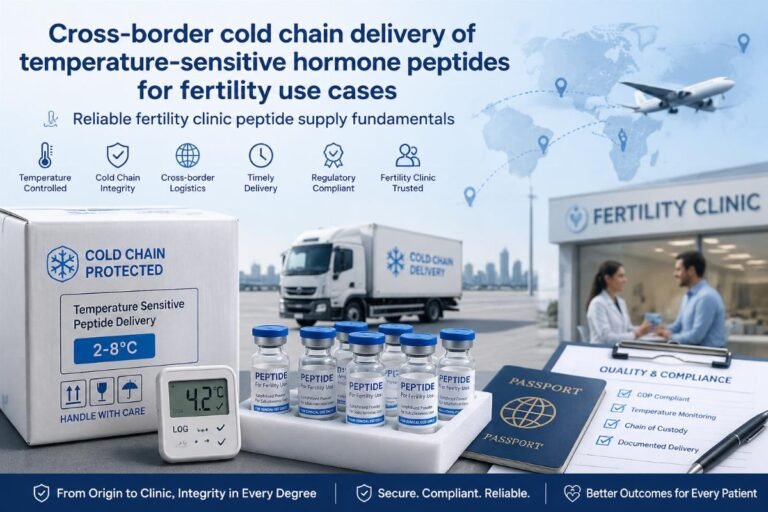
Cold-chain management is the single most underestimated cost layer in international peptide trade. Synthetic peptides, particularly those with susceptible residues like methionine or cysteine, degrade under temperature excursion. Maintaining a continuous cold chain from the lyophilization facility through international transit to the buyer’s receiving dock requires insulated shippers, phase-change coolant packs, and continuous temperature data loggers.
The cost of these materials is fixed per shipment, not per gram. A small order absorbs that fixed cost entirely into a few grams of product, inflating the effective peptide cost per gram dramatically. A full pallet-sized shipment spreads the same packaging cost across kilograms of material, bringing the per-gram impact down to a minor fraction.
Documentation costs follow a similar logic. A basic certificate of analysis covers identity and approximate purity. A full analytical package including HPLC chromatograms, mass spectrometry confirmation, residual solvent analysis by GC, moisture content by Karl Fischer, and endotoxin testing for certain applications adds meaningful cost per batch. Buyers who request the full package after receiving a basic-quote shipment effectively face a cost increase they did not anticipate.
| Hidden Cost Block | Small Order Impact | Large Order Impact |
|---|---|---|
| Cold-chain packaging and loggers | High per-gram burden | Low per-gram burden |
| Analytical documentation per batch | Significant per-gram addition | Minor per-gram addition |
| Customs and regulatory clearance | Fixed fee spread over few grams | Fixed fee spread over many grams |
| Specialized handling surcharges | Noticeable per-gram effect | Negligible per-gram effect |
[NEED_CITE: cold-chain logistics cost structure for temperature-sensitive pharmaceutical ingredients]
On one occasion, a buyer in Indonesia received a shipment where the temperature logger showed an excursion lasting several hours during a weekend layover at a transit hub. The peptide itself was intact by HPLC, but the buyer’s internal protocol required rejection of any shipment with a logged excursion, regardless of analytical results. The replacement shipment, expedited under tighter cold-chain controls, carried a substantially higher effective peptide cost per gram because the expedited freight and dedicated temperature-controlled container costs fell across the same small quantity.
The lesson is to build cold-chain and documentation costs into the comparison from the first quote request, not as an afterthought.
How to Request an Accurate Bulk Peptide Quote?
An accurate bulk peptide quote requires the buyer to specify purity grade, target quantity range, cold-chain requirements, documentation level, and destination logistics clearly upfront.
Vague inquiries generate vague quotes, and vague quotes lead to disputes later. The most efficient way to obtain a comparable peptide cost per gram across multiple suppliers is to provide a structured specification package that removes ambiguity.
Here is the parameter set I ask every serious buyer to include in their inquiry:
- Peptide identity and sequence, including any modifications such as acetylation, palmitoylation, or amidation.
- Target purity grade, stated as a minimum acceptable threshold rather than a vague "high purity" request.
- Quantity range, expressed as a minimum and maximum expected annual volume, not just a single trial quantity.
- Cold-chain requirement, specifying whether ambient-stable shipping is acceptable or whether continuous refrigerated or frozen transit is mandatory.
- Documentation tier, listing every analytical test and certificate required for your regulatory filing or internal QC protocol.
- Destination and incoterm preference, because freight structure and customs handling vary significantly by route.
[NEED_CITE: best practices for requesting quotations on custom peptide synthesis]
A buyer who provides this level of detail receives a quote where the peptide cost per gram is directly comparable across suppliers. A buyer who sends a one-line inquiry asking for "best price on copper peptide" receives quotes that are not comparable because each supplier has made different assumptions about purity, packaging, and documentation.
When I receive a well-structured inquiry, I can itemize the cost blocks transparently: raw synthesis, purification tier, lyophilization and fill, cold-chain packaging, analytical testing, and freight. That itemization lets the buyer see exactly where adjustments can reduce the effective peptide cost per gram without compromising the parameters that matter for their application.
Conclusion
The peptide cost per gram is never a single number; it is the visible tip of a layered cost structure. Purity grade, order volume relative to fixed cost thresholds, cold-chain rigor, and documentation depth all shape the final figure. Buyers who request itemized quotes at multiple volume points and match purity specifications to actual formulation needs consistently achieve better effective pricing than those who chase the lowest headline number.
Leave a Reply