Buy Semaglutide API for Clinical Trials from cGMP Manufacturer
High purity is not enough for regulatory approval.
Sourcing Semaglutide API for clinical trials requires more than a certificate of analysis showing 99% purity. It demands a complete regulatory dossier, including Drug Master File (DMF) references, full batch traceability, and validated cold-chain logistics. Without these documents, regulatory bodies like the FDA or EMA will reject Investigational New Drug (IND) applications, regardless of the chemical quality of the powder. Buyers must prioritize cGMP compliance and documentation integrity over minor cost savings to avoid costly trial delays.
I still remember the silence on the phone line when a client in Brazil told me their ANVISA submission had been rejected. We had provided a beautiful white powder, high-performance liquid chromatography (HPLC) reports that looked perfect, and a competitive price. But we missed one critical piece: a referenced DMF and a complete chain of custody for the raw materials. The regulator did not care about the purity; they cared about the paper trail. That failure taught me that in the pharmaceutical world, the document is as valuable as the molecule. [NEED_CITE: FDA guidelines on IND submissions and API documentation requirements]
This guide breaks down the specific pitfalls of sourcing peptide APIs for human trials and explains how to verify that your supplier can actually support your regulatory timeline.
Why Standard Research Grade APIs Fail in Clinical Trials?
The biggest misconception in early-stage procurement is that "research grade" and "clinical grade" are interchangeable if the purity is high. They are not. Research suppliers often operate under ISO 9001 or no specific quality framework, focusing on speed and cost. Clinical trial sponsors, however, operate under current Good Manufacturing Practices (cGMP). The gap between these two standards is where most trial delays occur.
When you buy Semaglutide API for clinical trials, you are not just buying a chemical; you are buying an audit trail. Regulatory auditors need to see exactly where every starting material came from, how it was stored, and who handled it. A research supplier might synthesize a batch using reagents from unverified sources, leaving gaps in the impurity profile that only show up during rigorous toxicology studies.
| Feature | Research Grade Supplier | cGMP Compliant Manufacturer |
|---|---|---|
| Quality System | ISO 9001 or Internal QC | cGMP & ISO 9001 Certified |
| Documentation | Basic CoA | Full Batch Record & DMF Reference |
| Traceability | Limited to final batch | Full raw material to finished API |
| Impurity Profile | General identification | Batch-specific detailed profiling |
| Regulatory Support | None | Active DMF & REACH Support |
[NEED_CITE: Comparison of GMP vs non-GMP manufacturing standards for pharmaceutical APIs]
A European CDMO once shared how they had to discard an entire preclinical batch because the API supplier could not provide the specific solvent residue data for that exact lot. The supplier had a general spec sheet, but not the batch-specific data required for the toxicity study. This is why verifying the manufacturer’s ability to provide batch-traceable documentation is the first step in sourcing Semaglutide API for clinical trials. Without this, you cannot prove safety to regulators.
Key Documents Every Clinical Trial Buyer Must Demand
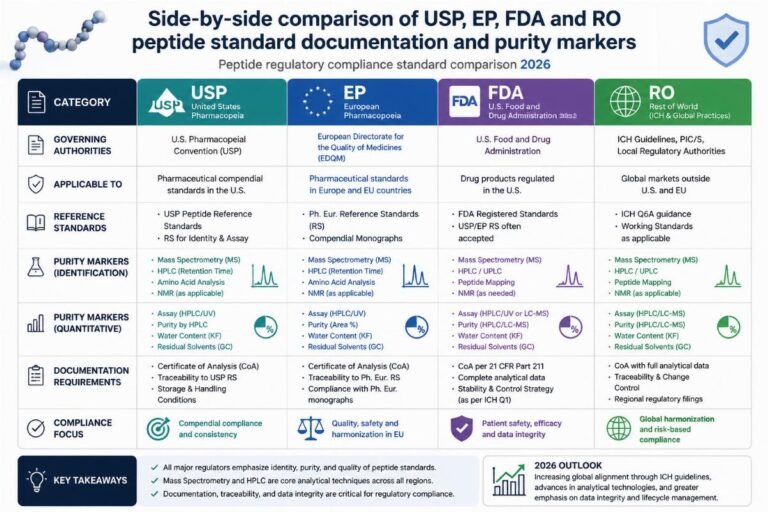
Beyond the standard Certificate of Analysis (CoA), there is a specific set of documents that separates a compliant supplier from a risky one. Many buyers stop at the CoA, assuming it covers all bases. It does not. The CoA only tells you what the product looks like at the time of testing. It does not tell you how it was made or if the process is consistent.
To ensure your Semaglutide API for clinical trials is ready for regulatory submission, you must demand the following:
- Drug Master File (DMF) Reference: An active DMF allows regulators to review the manufacturing process without disclosing proprietary information to the sponsor. If a supplier cannot provide a DMF number or a letter of access, they are not ready for clinical supply. [NEED_CITE: FDA guidance on Drug Master Files for API manufacturers]
- Batch Traceability Records: This includes the source of all starting materials, reagents, and solvents. You need to know if the amino acids used in the synthesis were sourced from approved vendors.
- Stability Data: Real-time and accelerated stability studies that prove the API remains stable under defined storage conditions. This is crucial for determining the shelf life during your trial.
- Impurity Profile: A detailed report identifying all known and unknown impurities, especially those above the identification threshold. Regulators reject INDs if the impurity profile is not fully characterized.
A client in North America nearly faced a six-month delay because their supplier provided a "GMP-like" CoA but no actual batch production records. When the auditor asked for the cleaning validation logs of the reactor used for their specific batch, the supplier had nothing. The trial was put on hold until a new batch from a compliant source was secured. This highlights why Semaglutide API for clinical trials must come with full transparency, not just a final test result.
How to Verify Cold Chain Integrity for Peptide APIs
Peptides are fragile. Semaglutide, in particular, is sensitive to temperature fluctuations. A common failure point in global sourcing is the assumption that "shipping with ice packs" is sufficient. For clinical trials, where every milligram counts and timelines are tight, a temperature excursion can ruin the entire shipment and invalidate the batch.
Validating the cold chain is not just about the packaging; it is about the data. You need to know the temperature history of your specific package from the moment it left the manufacturer’s warehouse until it arrived at your site.
- Validated Packaging: The supplier should use packaging that has been tested to maintain specific temperatures for a defined duration, accounting for worst-case transit scenarios.
- Real-Time Monitoring: Use of data loggers that record temperature at regular intervals. This data should be downloadable and verifiable upon receipt.
- Excursion Protocols: Clear procedures for what happens if a temperature excursion occurs. Does the supplier have stability data to support short-term excursions? If not, the batch must be quarantined.
I recall a shipment to a research institute in Germany where the external packaging looked fine, but the internal data logger showed a spike to 25°C for four hours during a layover. Because the supplier had no stability data to support this excursion, the client had to treat the material as compromised. For Semaglutide API for clinical trials, this risk is unacceptable. You must ensure your supplier has validated cold-chain protocols and provides the monitoring data as part of the deliverable. [NEED_CITE: WHO guidelines on temperature-controlled transport of pharmaceuticals]
Red Flags in Semaglutide API Supplier Selection
Not all suppliers who claim to be "GMP compliant" actually are. The market is flooded with traders who rebrand research chemicals as pharmaceutical grade. Identifying these red flags early can save you from significant financial and regulatory headaches.
- Lack of Audit Trail: If a supplier cannot provide detailed batch records or refuses to share the origin of their raw materials, this is a major warning sign. Transparency is non-negotiable in cGMP environments.
- Vague Origin of Raw Materials: Suppliers who cannot specify where their starting amino acids or reagents come from are likely cutting corners. This lack of control leads to inconsistent impurity profiles.
- Inability to Provide Custom Synthesis Records: For a complex molecule like Semaglutide, the synthesis process is critical. A legitimate manufacturer will have detailed records of each synthesis step, including purification methods. Traders often lack this depth of knowledge.
- No Physical Address or Lab Facilities: Verify that the supplier has actual manufacturing capabilities. Many "manufacturers" are just trading companies with no physical production site. Requesting a virtual or physical audit can quickly reveal the truth.
A buyer from Asia once selected a supplier based solely on price. When they requested a video tour of the production facility, the supplier made excuses and delayed repeatedly. Eventually, it was revealed that the supplier was merely repackaging bulk powder from an unknown source. The resulting API had inconsistent potency, causing variability in preclinical results and wasting months of work. When sourcing Semaglutide API for clinical trials, always verify the manufacturer’s physical presence and technical capability.
Conclusion
Regulatory readiness is more valuable than low cost.
Sourcing Semaglutide API for clinical trials is a complex process that extends far beyond checking purity levels. It requires a partner who understands the regulatory landscape, provides comprehensive documentation like DMFs and batch records, and ensures the integrity of the product through validated cold-chain logistics. By prioritizing these factors, pharmaceutical manufacturers and CDMOs can avoid costly delays and ensure their trials proceed smoothly. Always verify the supplier’s cGMP status and demand full transparency in their processes.
Leave a Reply