
Cosmetic Peptide Manufacturer for Russia: China Factory Direct Wholesale
Purity on paper means nothing if the peptide arrives clumped, denatured, or held up at customs without documentation.
When sourcing from a Cosmetic Peptide Supplier Russia buyers must prioritize three things above unit price: GMP-grade batch documentation (COA + HPLC), validated cold-chain logistics, and consistent peptide activity upon arrival—not just initial purity readings.
I started my career in peptide quality control at a manufacturing facility in Qingdao, running HPLC assays and moisture-content tests before anything left the lab. One of my earliest export orders was a bulk Argireline shipment to a Russian skincare brand. The HPLC report showed excellent purity, the vials looked perfect, and the COA was signed off. Forty days later, the cargo reached Vladivostok via standard sea freight—and the lyophilized powder had caked into solid lumps. The client could not reconstitute it. We absorbed the freight cost, reshipped a replacement batch via temperature-controlled express, and learned a lesson that reshaped how I handle every order to Russia: the peptide supply chain is only as strong as its weakest temperature link.
That experience exposed a pattern I now see across dozens of Russian procurement inquiries. Buyers focus heavily on per-gram pricing and purity claims, yet the real cost drivers sit elsewhere—in documentation gaps, temperature excursions during transit, and formulation incompatibilities discovered only after the powder reaches the lab. A reliable Cosmetic Peptide Supplier Russia partners with must address all three before a single gram is weighed.
Where Do Russian Buyers Face the Highest Risk When Sourcing Peptides from China?
Cold-chain failure and incomplete GMP documentation are the two largest hidden cost centers, and they rarely appear on the initial quotation.
Peptides such as Argireline, Matrixyl, and GHK-Cu are biologically active sequences. Their efficacy in a finished serum or cream depends on conformational integrity, which is sensitive to moisture ingress and prolonged temperature fluctuation. Lyophilized powders are more stable than solutions, but they are not invulnerable. When a shipment sits in an unrefrigerated container crossing the Trans-Siberian rail corridor or waiting at a warehouse in Novosibirsk during summer, residual moisture inside the vial can trigger partial aggregation. The peptide does not decompose into something toxic—it simply loses the structural shape that binds to its target receptor. The result is a raw material that passes HPLC purity testing yet underperforms in the final formulation.
Documentation risk is equally damaging. Russian customs and regulatory bodies require verifiable certificates of analysis, and increasingly, cosmetic brands selling in the Eurasian Economic Union need ISO-aligned quality records. A Cosmetic Peptide Supplier Russia buyers trust must provide batch-specific COAs, HPLC chromatograms, and where applicable, residual solvent and heavy metal test results. Self-reported certificates printed without analytical backing create clearance delays and, worse, formulation failures that only surface months later.
A Moscow-based contract manufacturer once shared that they switched away from a European peptide distributor not because of quality issues, but because lead times stretched unpredictably and custom blend requests took weeks to confirm. The Chinese factory they moved to responded to technical queries within a single business day and delivered a tailored Matrixyl and Snap-8 blend with full analytical documentation in parallel with production. Responsiveness, in this market, is a competitive advantage that price alone cannot replicate.
How Can Russian Buyers Verify the Quality of a Chinese Peptide Factory?
HPLC chromatograms, batch-level COAs, and third-party verification form the minimum credible documentation floor.
High-Performance Liquid Chromatography is the industry-standard method for confirming peptide purity. A credible Cosmetic Peptide Supplier Russia buyers engage should provide a full chromatogram—not just a summary purity figure—with each shipment. The chromatogram reveals not only the main peak percentage but also the presence and identity of related impurities, deletion sequences, and truncated peptides that a single number would hide.
Beyond HPLC, buyers should expect the following documentation package per batch:
| Document Type | Minimum Standard | Preferred Standard |
|---|---|---|
| Certificate of Analysis | Batch-specific, signed | Includes test method references |
| HPLC Chromatogram | Full raw chromatogram attached | With peak identification table |
| Moisture Content (Karl Fischer) | Reported per batch | Within controlled range for lyophilized powder |
| Residual Solvents | Compliant with ICH guidelines | Tested by GC method |
| Heavy Metals | Within cosmetic-grade limits | Third-party verified |
| GMP / ISO Alignment | Self-declared | ISO 22716 or equivalent audit available |
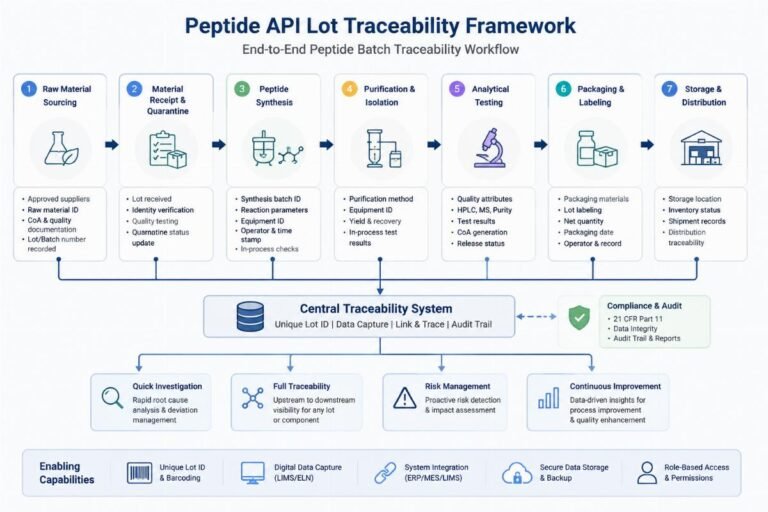
A St. Petersburg distributor importing multiple peptide SKUs for the first time raised a valid concern: how to confirm that the sample they tested matches the bulk production batch. The answer lies in requesting batch-traceable documentation where the sample lot number, production date, and analytical results are cross-referenced. A serious manufacturer maintains this traceability as standard practice.
Third-party testing adds another layer. Buyers who need independent confirmation can send received samples to accredited laboratories in Russia or internationally. The cost is modest relative to the risk of formulating with a compromised active.
Which Cosmetic Peptides Should Russian Formulators Prioritize and How Do They Compare?
Selection depends on the target claim—anti-wrinkle, firming, brightening, or hair growth—and each peptide has distinct solubility, stability, and recommended usage concentrations.
A Cosmetic Peptide Supplier Russia formulators work with should offer clear technical guidance, not just a product list. Below is a functional comparison of the most requested peptides in the Russian anti-aging and skincare market:
| Peptide | INCI Name | Primary Function | Solubility | Recommended Use Level | Stability Note |
|---|---|---|---|---|---|
| Argireline | Acetyl Hexapeptide-8 | Wrinkle relaxation (Botox-like) | Water-soluble | Moderate range | Sensitive to prolonged heat; cold-chain essential |
| Matrixyl | Palmitoyl Pentapeptide-4 | Collagen stimulation | Oil-soluble (lipid-conjugated) | Moderate range | Stable in emulsion systems |
| GHK-Cu | Copper Tripeptide-1 | Firming, repair, anti-inflammatory | Water-soluble | Low to moderate range | Incompatible with strong acids and certain preservatives |
| Snap-8 | Acetyl Octapeptide-3 | Expression line reduction | Water-soluble | Moderate range | Similar handling to Argireline |
| Palmitoyl Tripeptide-1 | — | Matrix support, firming | Oil-soluble | Moderate range | Best in emulsion or anhydrous systems |
| Palmitoyl Tetrapeptide-7 | — | Anti-inflammatory, firming | Oil-soluble | Moderate range | Often combined with Palmitoyl Tripeptide-1 |
A Russian skincare brand developing a dual-peptide anti-aging serum needed guidance on combining water-soluble and lipid-soluble actives without destabilizing the emulsion. The formulation support provided by their Chinese supplier helped them sequence the addition phases correctly and avoid a compatibility issue that would have reduced efficacy noticeably.
Formulation concentration is another area where guidance matters. More peptide does not mean better results—exceeding recommended levels can cause solubility limits to be breached, leading to precipitation or reduced skin penetration. Technical data sheets from a qualified Cosmetic Peptide Supplier Russia buyers rely on should include recommended usage ranges and incompatibility warnings.
What Are the Logistics Options for Shipping Peptides to Russia and How Do They Compare?
The choice between cold-chain express and standard freight depends on peptide sensitivity, order volume, and acceptable risk tolerance—not just shipping cost.
Shipping peptides to Russia involves crossing multiple climate zones and handling points. A Cosmetic Peptide Supplier Russia clients depend on must offer transparent logistics options with clear trade-offs:
| Shipping Method | Transit Time | Temperature Control | Risk Level | Best Suited For |
|---|---|---|---|---|
| DHL / FedEx Express (with gel packs) | Short | Controlled within insulated packaging | Noticeably reduced | Samples, urgent production batches, heat-sensitive peptides |
| Air Freight (temperature-controlled) | Moderate | Controlled | Standard | Mid-size orders with moderate timeline |
| Sea Freight (standard container) | Extended | Uncontrolled | Noticeably elevated | Large bulk orders of stable peptides, non-temperature-sensitive raw materials |
| Rail Freight (Trans-Siberian) | Extended | Seasonally variable | Variable | Cost-sensitive bulk; summer months carry higher risk |
For lyophilized peptides like Argireline and GHK-Cu, the manufacturer’s cold-chain protocol typically includes gel packs or dry ice (depending on the required temperature range), insulated containers, and temperature indicator labels that record whether the shipment experienced an excursion. This packaging adds cost but protects the active.
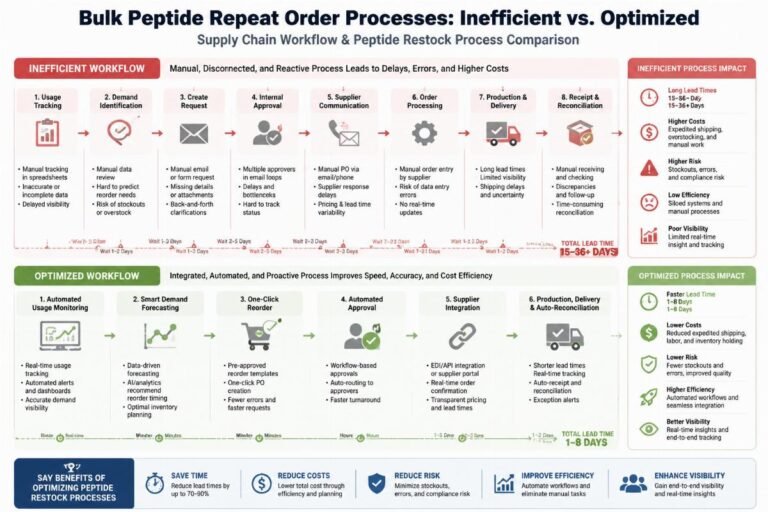
A Russian distributor importing a broad catalog of peptide SKUs for the first time chose express shipping for the initial order despite the higher per-kilogram cost. The reasoning was straightforward: the cost of a failed batch—measured in reformulation time, delayed product launches, and reputational damage—far exceeded the shipping premium. Subsequent larger orders shifted to air freight with validated insulation once the supplier’s packaging protocol was proven reliable.
The key is not to default to the cheapest option but to match the shipping method to the peptide’s sensitivity profile and the buyer’s production timeline.
What Does the Complete Procurement Process Look Like from Inquiry to Delivery?
A structured, document-driven workflow protects both buyer and supplier and ensures the peptide arrives in formulation-ready condition.
Working with a Cosmetic Peptide Supplier Russia buyers partner with should follow a clear sequence:
Step 1 — Technical Inquiry and Specification Confirmation
The buyer submits the target peptide, quantity, and intended application. The supplier responds with a specification sheet including purity grade, particle size (if relevant), solubility data, and recommended storage conditions. Any custom requirements—such as a specific blend ratio or particle size distribution—are confirmed at this stage.
Step 2 — Documentation Review
Before any payment is made, the buyer reviews sample COAs, HPLC chromatograms from recent batches, and GMP or ISO alignment statements. This step eliminates suppliers who cannot provide verifiable records.
Step 3 — Sample Shipment and Verification
A small sample batch is shipped via express with cold-chain packaging. The buyer’s laboratory reconstitutes the peptide, runs independent HPLC if needed, and conducts a small-scale formulation trial. This step confirms that the peptide performs as expected in the actual formulation system.
Step 4 — Production Order and Batch Documentation
Upon sample approval, the production order is placed. The manufacturer assigns a batch number, runs production under GMP-aligned conditions, and generates batch-specific analytical documents. These documents are shared with the buyer before shipment.
Step 5 — Cold-Chain Dispatch and Tracking
The finished batch is packaged with appropriate temperature-control materials and dispatched. Tracking information and temperature indicator status are shared with the buyer in real time.
Step 6 — Customs Clearance and Delivery
Complete documentation—commercial invoice, packing list, COA, and any required certificates—accompanies the shipment. A well-prepared Cosmetic Peptide Supplier Russia buyers work with ensures that documentation is formatted to meet Eurasian customs requirements, minimizing clearance delays.
A European contract manufacturer that sources from China follows this exact sequence and reports that the upfront documentation work eliminates nearly all downstream disputes. The process takes slightly longer at the start but compresses the overall timeline by preventing rework.
Conclusion
Sourcing cosmetic peptides from China into Russia is a documentation and logistics challenge as much as a purchasing decision.
A Cosmetic Peptide Supplier Russia buyers select must deliver verifiable batch analytics, maintain cold-chain integrity across a complex transit route, and provide formulation-grade technical support. Purity claims are the starting point, not the finish line. The suppliers who win long-term partnerships in this market are those who treat temperature control, document traceability, and responsive communication as core product features—not afterthoughts.
Leave a Reply