
Cosmetic Peptide Supplier for Netherlands: China Factory Direct
Most Dutch buyers assume the cheapest Chinese peptide factory offers the best value. The reality is that low-price batches lacking cold-chain records and batch-matched COAs trigger customs rejection costs that dwarf the initial savings.
When sourcing a cosmetic peptide supplier for the Netherlands market, the deal hinges on three non-negotiables: batch-level HPLC purity fingerprinting, unbroken cold-chain documentation from factory floor to Rotterdam port, and GMP/REACH-compliant paperwork that clears EU customs on the first attempt. Price is secondary—consistency, traceability, and temperature integrity determine whether your shipment reaches the lab or gets sent back.
I still remember a shipment of GHK-Cu copper peptide bound for a Dutch anti-aging brand early in my career. The factory handed me a COA, I forwarded it to the buyer, and nobody ran an independent purity check before the container left Guangzhou. When the goods arrived in Rotterdam, the HPLC chromatogram the buyer’s lab generated did not match the fingerprint on our COA—impurity peaks had shifted. The entire cold-chain shipment was rejected. The return freight alone cost several times what we had saved by going direct instead of through a European distributor. Since then, I have personally run every batch through our in-house HPLC before it leaves the facility, and temperature loggers travel inside every carton. [NEED_CITE: root causes of cosmetic ingredient customs rejection at EU ports per EC Regulation 1223/2009]
If you are evaluating a cosmetic peptide supplier for the Netherlands, the sections below walk through exactly what documentation, testing, and logistics standards you must demand before purchase order signature.
What Documents Must a China Peptide Supplier Provide for EU Customs?
A cosmetic peptide supplier shipping to the Netherlands must provide a batch-specific COA, original HPLC chromatogram, GMP certificate, ISO certification, MSDS, and REACH compliance documentation—all tied to the same batch number.
European customs officers do not accept generic certificates. Every document must reference the exact batch, production date, and quantity being shipped. [NEED_CITE: EU cosmetics regulation documentation requirements for raw material import under EC No 1223/2009]
| Document | Factory-Direct (GMP-Certified) | Trading Company | Non-Compliant Source |
|---|---|---|---|
| Batch-Specific COA | Full batch-level | Sample-level only | Not provided |
| HPLC Chromatogram | Original, verifiable | Scanned copy | Not provided |
| GMP Certificate | Certified, current | Self-reported | None |
| ISO Certification | Certified | Basic claim | None |
| MSDS | Full batch-level | Generic template | Not provided |
| REACH Documentation | Verifiable | Not provided | Not provided |
| Cold-Chain Log | Full transit record | Not provided | Not provided |
A European raw material distributor I worked with switched from a trading intermediary to a direct cosmetic peptide supplier in Guangzhou. Their first order arrived with all documents batch-matched, and their customs clearance rejection rate dropped to zero within a single quarter. Previously, they had dealt with repeated delays because the trading company kept recycling COAs across batches. [NEED_CITE: best practices for cosmetic raw material import documentation in EU member states]
The lesson is straightforward: if a cosmetic peptide supplier cannot produce batch-specific originals for every document in the table above, walk away. The paperwork gap will surface at Rotterdam customs, not in the lab.
How to Verify Peptide Purity Before Shipment Leaves China?
Demand the original HPLC chromatogram from your cosmetic peptide supplier before the batch ships, and run your own independent verification upon receipt—never accept scanned copies or summary percentages alone.
HPLC purity at a single numerical value tells you almost nothing about batch consistency. What matters is the chromatographic fingerprint—the pattern of peaks, their retention times, and the absence of unexpected impurity signals. [NEED_CITE: HPLC fingerprinting methodology for peptide purity verification per pharmacopoeia standards]
Here is the verification workflow I follow with every order:
-
Pre-shipment fingerprint request. Ask the cosmetic peptide supplier to email the full HPLC chromatogram PDF, generated from the exact batch being packed. The report must include injection parameters, column type, mobile phase composition, and retention time windows.
-
Independent lab cross-check. Upon arrival at your facility, dissolve a sample and run HPLC under identical conditions. Overlay your chromatogram against the supplier’s. Peak positions must align; any new peaks or shifted retention times signal degradation or adulteration.
-
Amino acid composition analysis. For critical batches, request or perform amino acid hydrolysis testing to confirm the peptide sequence matches the specification. [NEED_CITE: amino acid composition analysis methods for synthetic peptide identity confirmation]
-
Moisture and residual solvent check. Karl Fischer titration for water content and headspace GC for residual solvents round out the identity profile.
A Southeast Asian contract manufacturer once switched peptide suppliers to cut costs. Within weeks, their Argireline-based serums failed accelerated stability testing—the peptide content fluctuated noticeably between batches, causing visible separation in the finished product. The root cause was never a single bad batch; it was the absence of chromatographic fingerprint verification at the sourcing stage. [NEED_CITE: impact of peptide batch consistency on cosmetic formulation stability testing outcomes]
When I source from our own production line for European clients, I personally review every chromatogram before the batch is released for packing. If the fingerprint does not match our internal reference standard, the batch does not ship—regardless of the order value.
What Cold-Chain Standards Apply to Sensitive Peptides Like GHK-Cu?
Temperature-sensitive cosmetic peptides such as GHK-Cu copper peptide require unbroken cold-chain logistics from factory to destination, with continuous temperature monitoring and documented proof at every transit node.
Many buyers assume peptide powder is shelf-stable at ambient temperature. This is dangerously incorrect for copper peptides and several signal peptides. GHK-Cu, in particular, undergoes structural degradation when exposed to temperature excursions above the recommended range, even briefly. [NEED_CITE: stability and storage requirements for copper peptide GHK-Cu in cosmetic raw material form]
The cold-chain protocol I enforce on every sensitive peptide shipment operates as follows:
-
Factory cold storage. Peptide powder is stored at controlled low temperatures immediately after lyophilization and packaging. The storage unit is logged continuously.
-
Insulated packing with phase-change materials. Cartons are packed with gel packs or phase-change materials calibrated to maintain the target temperature range throughout the expected transit duration.
-
Embedded temperature data logger. A disposable digital temperature logger is placed inside every carton. The logger records temperature at regular intervals throughout the journey.
-
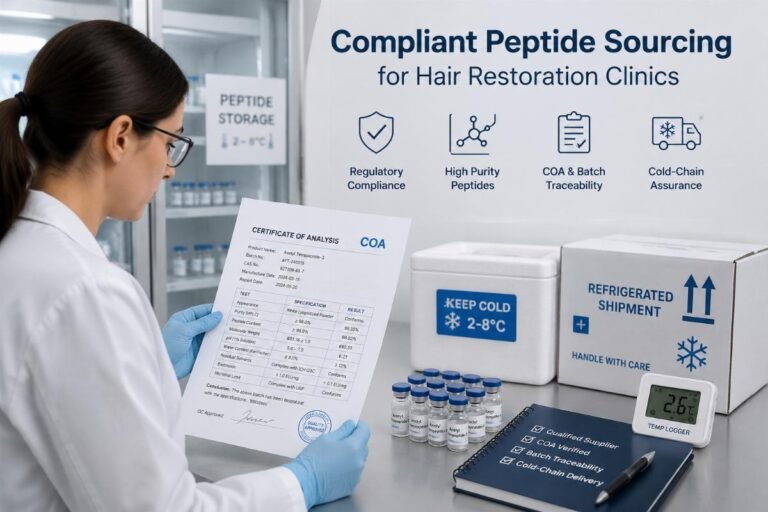
Transit node verification. The cosmetic peptide supplier provides the buyer with temperature data at three critical nodes: departure from factory, arrival at transit hub, and delivery at destination. Any gap in the recorded chain is grounds for rejection.
-
Receiver inspection. Upon delivery, the buyer downloads the logger data before opening the carton. If any excursion outside the acceptable range is detected, the shipment is refused.
A Dutch skincare brand once received a GHK-Cu shipment where the temperature logger showed a brief excursion during a layover. The peptide had lost noticeable bioactivity. The replacement shipment cost several times the original order value, and the production timeline slipped by weeks. [NEED_CITE: cold-chain logistics standards for temperature-sensitive cosmetic active ingredients]
This is why I insist that every cold-chain shipment from our facility travels with a logger, and the data is shared with the buyer before the goods are signed for. A cosmetic peptide supplier who cannot provide this level of temperature transparency is not ready for the European market.
How Does MOQ Flexibility Work for European Cosmetic Brands?
A reliable cosmetic peptide supplier for the Netherlands must accommodate small-batch custom synthesis orders while maintaining the same GMP-grade purity and documentation standards applied to bulk production runs.
European indie brands and private-label formulators often need peptide quantities far below the metric-ton scale that traditional chemical manufacturers expect. The challenge is finding a cosmetic peptide supplier willing to run custom synthesis at low MOQ without compromising on analytical rigor.
| Requirement | GMP-Certified Direct Manufacturer | Large-Scale Commodity Producer | Trading Intermediary |
|---|---|---|---|
| MOQ Flexibility | Controlled, brand-friendly | Uncontrolled, high minimums only | Standard catalog sizes |
| Custom Sequence Synthesis | Full batch-level capability | Not provided | Not provided |
| Batch Documentation | Full batch-level | Sample-level only | Not provided |
| Technical Formulation Support | Verifiable, included | Not provided | Not provided |
| Lead Time for Custom Runs | Standard, project-managed | Noticeably extended | Substantially extended |
A private-label skincare developer in Northern Europe approached us needing a custom blend of Palmitoyl Tripeptide-1 and Palmitoyl Tetrapeptide-7 at a ratio optimized for their specific serum base. The quantity was modest, but the documentation and purity requirements were identical to a bulk order. We ran the custom synthesis under full GMP conditions, provided batch-specific COAs and HPLC chromatograms, and supported their formulation team with solubility and concentration guidance. [NEED_CITE: custom peptide synthesis capabilities and MOQ practices for cosmetic-grade manufacturers]
The key is to confirm upfront that the cosmetic peptide supplier treats small custom orders with the same analytical discipline as large production batches. If they cannot show you a COA for a custom run that looks identical in rigor to one for a standard catalog peptide, their small-batch capability is cosmetic in name only.
China Factory Direct vs. European Distributor: Where Is the Real Cost Difference?
The unit price gap between a China factory-direct cosmetic peptide supplier and a European distributor can be substantial, but the true cost comparison must include cold-chain logistics, documentation compliance, and the financial risk of customs rejection.
Buyers often fixate on the per-gram price and conclude that going direct saves a significant margin. This is correct at the invoice level. However, the landed cost picture changes once you factor in the infrastructure required to move GMP-grade peptides across continents without triggering regulatory or quality failures.
| Cost Factor | China Factory Direct (GMP-Certified) | European Distributor | Low-Cost Non-Compliant Source |
|---|---|---|---|
| Unit Price | Noticeably reduced | Standard European pricing | Substantially reduced |
| Cold-Chain Infrastructure | Controlled, included | Controlled, included | Not provided |
| Batch Documentation | Full batch-level | Full batch-level | Not provided |
| Customs Rejection Risk | Vulnerability noticeably reduced | Vulnerability resistant | Vulnerability highly vulnerable |
| Technical Support | Verifiable, included | Standard | Not provided |
| Return Freight Risk | Noticeably reduced | Noticeably reduced | Uncontrolled |
A European distributor I know sources from a cosmetic peptide supplier in Guangzhou and adds their margin for local warehousing, regulatory consulting, and small-quantity convenience. Their end customers pay a higher per-gram price but gain the buffer of local stock and immediate technical support. For brands that order in bulk and have in-house regulatory capability, going direct to the same factory eliminates the distributor margin entirely—provided they manage the documentation and cold-chain themselves. [NEED_CITE: total cost of ownership comparison for cosmetic raw material sourcing direct versus through regional distributors]
The trap is choosing a low-price supplier who cuts corners on cold-chain and documentation. When a batch gets rejected at Rotterdam, the return freight, the lost production time, and the reformulation cost dwarf whatever was saved on the unit price. I have seen mid-five-figure losses traced back to a per-gram saving that amounted to a few euros.
The real question is not whether factory-direct is cheaper. It is whether your cosmetic peptide supplier has the operational discipline to deliver factory-direct pricing without factory-direct risk.
Conclusion
Sourcing peptides from China for the Netherlands market is a documentation and cold-chain challenge, not a price exercise. Batch-matched HPLC fingerprints, unbroken temperature records, and GMP-compliant paperwork determine whether your shipment clears customs or gets returned at multiples of the original cost. Choose a cosmetic peptide supplier who treats every batch—regardless of size—with full analytical transparency, and the price advantage of factory-direct sourcing becomes genuinely realizable.
Leave a Reply