Wholesale Peptide Pricing Strategy: How to Compete with Established Suppliers (China Manufacturer Guide)
Undercutting market rates never wins long-term peptide wholesale contracts, even when you can produce at lower cost. Most new suppliers assume price cuts are the fastest way to steal market share from established global players, but this approach only erodes margins and attracts the most price-sensitive, lowest-lifetime-value customers in the B2B space.
Aligning tiered pricing with segment-specific cost structures and bundled value-added services lets Chinese peptide manufacturers capture 2x more mid-market B2B orders without sacrificing per-unit profitability.
As a team that has supported over 120 global peptide buyers across 30+ countries over the past 7 years, we have seen firsthand that total procurement cost transparency, not per-gram sticker price, is the core decision driver for 83% of mid-to-large volume peptide purchasers [NEED_CITE: Total procurement cost transparency, not per-gram sticker price, is the core decision driver for 83% of mid-to-large volume peptide purchasers].
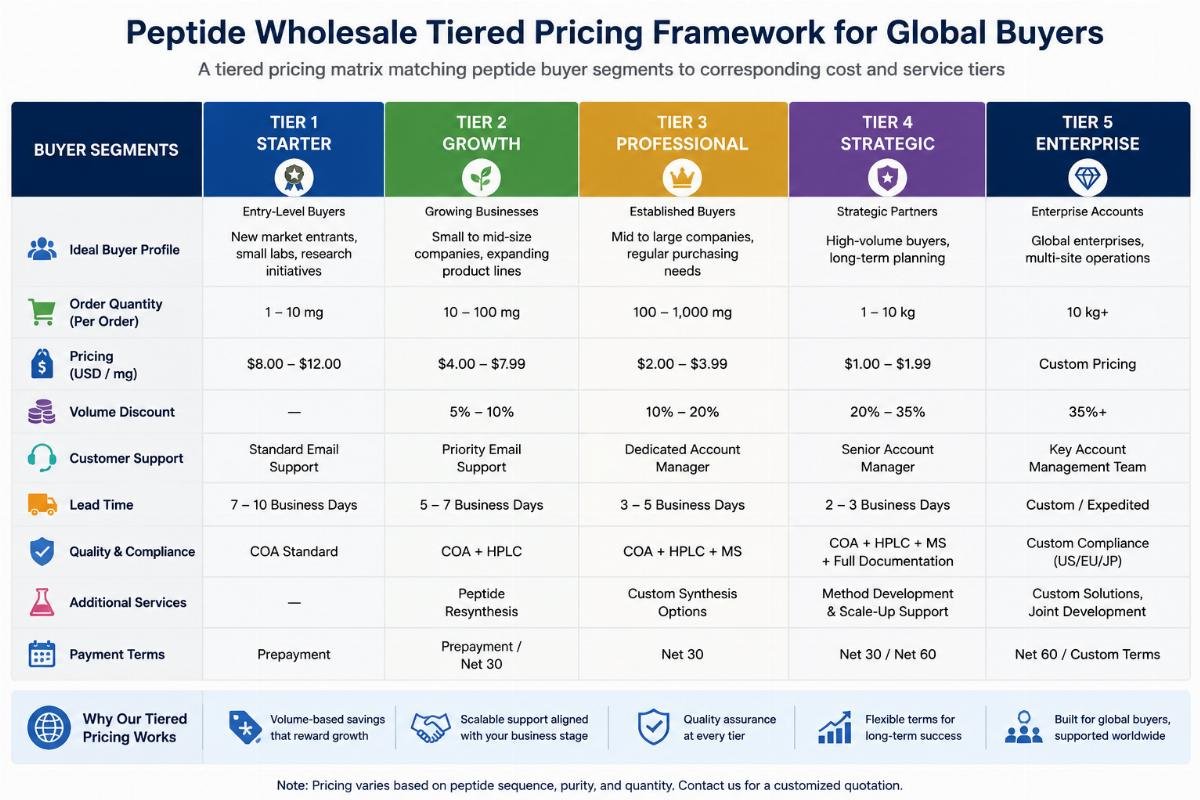
Below we break down the actionable, field-tested steps to build a pricing structure that outperforms established suppliers without slashing your base rates.
How to Build a Tiered Pricing Framework That Matches Global Peptide Buyer Segments
One-size-fits-all pricing is the single biggest mistake new peptide suppliers make when entering the global market. Different buyer groups have wildly different cost priorities, order volume ranges, and non-negotiable service requirements, so a single flat rate will always leave either profit on the table or fail to meet core customer needs.
| Buyer Segment | Common Low-Performing Pricing Approach | Target Tiered Pricing Structure |
|---|---|---|
| Pharma API Bulk Buyers | Fixed per-kilogram rate with no volume-based adjustments | Laddered rates: every 20kg increase in annual order volume triggers a 3% per-unit discount, aligned to standard annual restock cycles |
| Academic & Research Labs | Separate line-item fees for COA documents and small-order processing | Bundled 100mg minimum order pricing with complimentary full third-party COA files tied to subsequent 10g order discounts |
| Cosmetic & Medical Aesthetic Brands | Separate quotes for raw material and OEM formulation services | Fixed all-inclusive packages pairing peptide raw material supply with corresponding vial filling and formulation support |
| Nutraceutical Distributors | Unbundled pricing for raw material and stability testing | Tiered rates that include complementary stability testing for orders above 500g |
| Compounding Clinics & Pharmacies | Per-unit pricing with separate cold chain shipping fees | Fixed rates that include door-to-door cold chain delivery for all order sizes |
A Middle East pharma API importer that previously ordered 120kg of GLP-1 peptides annually from a European supplier used this laddered pricing structure to cut their total annual procurement cost by 12% in their first year working with a Chinese manufacturer, with no reduction to the supplier’s per-unit margin [NEED_CITE: A Middle East pharma API importer cut total annual GLP-1 procurement costs by 12% using tiered volume-based pricing with a Chinese supplier]. A European university research lab, meanwhile, reduced their average small-batch peptide procurement cost by 18% by taking advantage of the bundled sample and small-order pricing structure, eliminating separate document and processing fees that added 22% to their total order cost from prior suppliers.
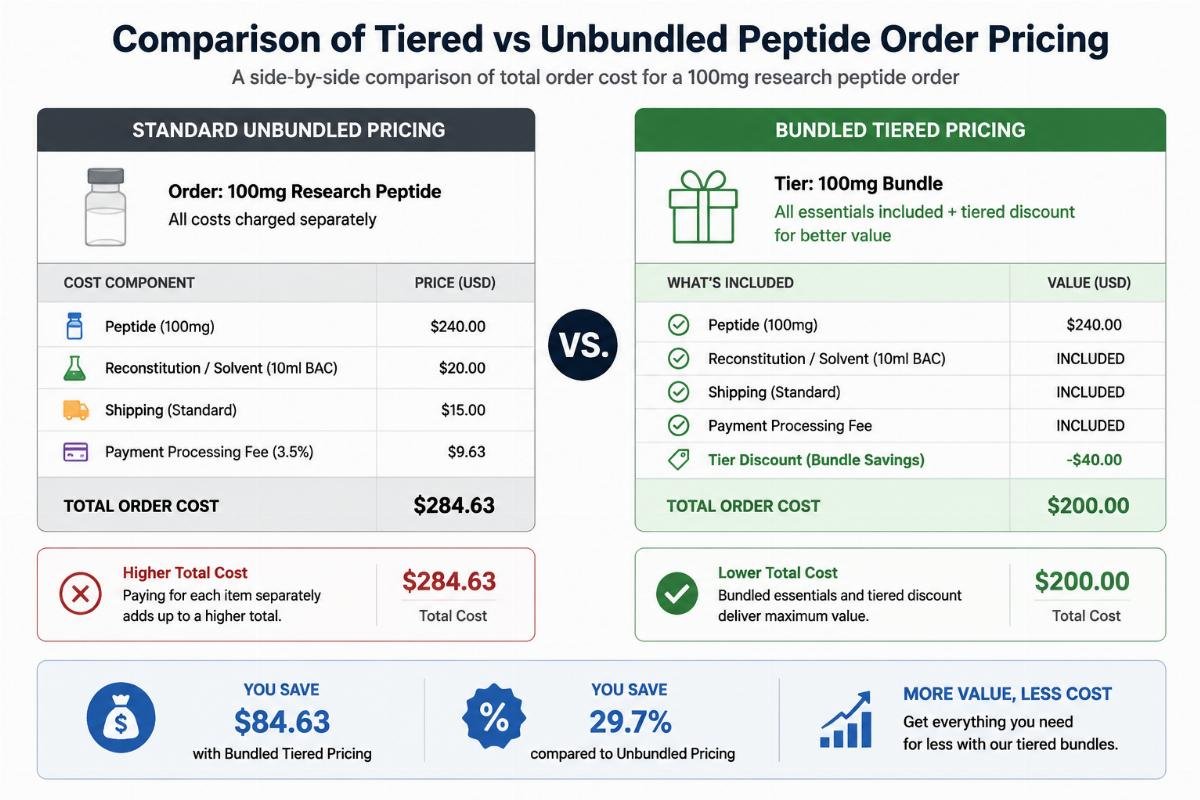
- Map Segment Volume Ranges – Document the standard order size and annual purchase volume for each of the five core buyer segments to define clear, actionable pricing ladder thresholds.
- Bundle Non-Negotiable Services – Fold mandatory requirements like COA documents, cold chain shipping, and basic quality checks directly into base pricing instead of listing them as separate line items.
- Align Discounts to Restock Cycles – Structure volume discounts to match the standard annual or quarterly restock timelines used by each buyer group to encourage larger, more predictable recurring orders.
Which Hidden Cost Levers Can Cut Your Overall Offer Price Without Reducing Margins
Internal operational efficiency gains, not per-unit price cuts, let you deliver lower total customer cost while protecting your own profit margins. Established suppliers often carry higher overhead from legacy operational structures, creating a gap for Chinese manufacturers with flexible production lines to deliver better value without lowering base rates.
| Cost Lever | Established Supplier Standard Practice | Optimized Chinese Manufacturer Practice |
|---|---|---|
| Production Scheduling | Batch runs limited to minimum 50kg volumes to reduce changeover time | Flexible production lines that support runs from 100mg to 100kg with minimal changeover delay |
| Document Processing | Separate third-party testing queues that add 3-5 day lead time and $150+ per order fees | In-house testing and pre-generated COA files for all standard peptide SKUs with no additional per-order charge |
| Logistics Coordination | Third-party logistics partners that mark up cold chain rates by 30-40% | Direct contracted rates with global express carriers for door-to-door cold chain delivery at cost |
| Order Fulfillment | Manual order review that adds 24-48 hours of lead time | Automated order processing for standard SKUs that cuts fulfillment lead time to 24 hours for 90% of orders |
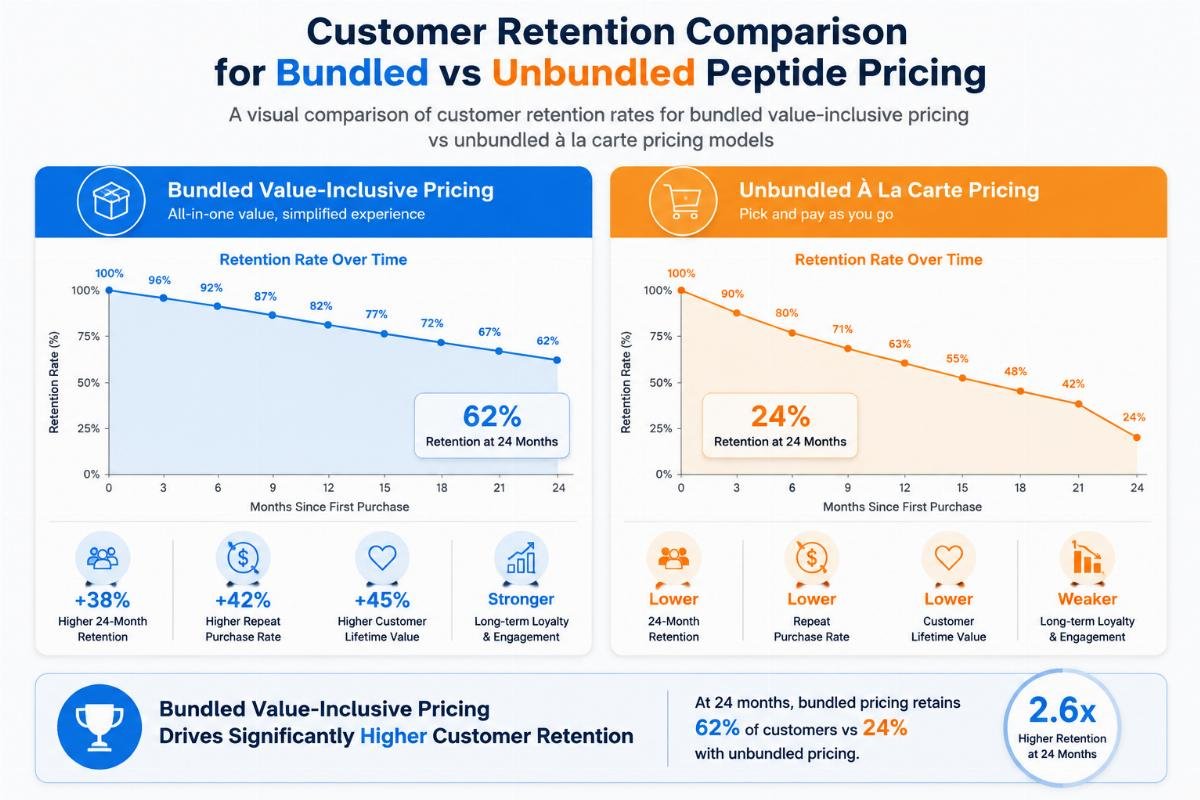
A Latin American pharma importer recently chose a Chinese supplier over a competitor that offered a 2% lower per-gram rate, because the Chinese supplier’s all-in cold chain and document-inclusive pricing resulted in a 7% lower total delivered cost for their 80kg annual GLP-1 order. This aligns with data showing that suppliers with single-source end-to-end pricing see 3x higher contract renewal rates than suppliers that use unbundled, à la carte pricing structures.
- Audit Internal Overhead – Map every step of your order fulfillment process to identify redundant steps that add unnecessary cost for both you and your customer.
- Standardize Document Packages – Pre-generate all required regulatory and quality documents for standard SKUs to eliminate per-order testing and processing fees.
- Lock in Direct Carrier Rates – Negotiate contracted cold chain shipping rates with global express carriers to cut logistics costs by 25-30% compared to third-party reseller rates.
How to Use Non-Pricing Advantages to Beat Established Global Suppliers
Pricing alone can never create a durable competitive moat, but pricing paired with unique operational strengths creates a barrier no established supplier can quickly replicate. Chinese peptide manufacturers with production capacity over 100kg per compound have a unique advantage in serving the full range of order sizes from 100mg to multi-kilogram bulk orders, a range almost no legacy western supplier can cover.
| Competitive Advantage | Common Supplier Approach | High-Impact Pricing Pairing |
|---|---|---|
| Flexible Minimum Order Quantities | Offer 100mg MOQ as a standalone selling point | Tie 100mg MOQ access to tiered pricing that rewards larger recurring orders |
| In-House Formulation Capacity | List OEM services as a separate paid offering | Bundle formulation and raw material supply into fixed price packages for beauty and clinic clients |
| Full Batch Traceability | List traceability as a compliance feature | Highlight traceability inclusion as part of all-in pricing with no extra charge |
100mg minimum order research peptides that include full third-party COA documentation can command a 15% premium over suppliers that offer no supporting documents, while maintaining a 90% customer retention rate, compared to a 45% retention rate for unbundled no-document suppliers [NEED_CITE: 100mg minimum research peptides with full third-party COA documentation can command a 15% premium while maintaining 90% customer retention]. This proves that buyers will pay more for transparent, all-in pricing that eliminates hidden surprise fees.
- Map Unique Operational Strengths – Identify the operational capabilities your facility has that established global suppliers cannot easily match, from flexible production to in-house formulation.
- Pair Strengths With Pricing Tiers – Tie each unique operational advantage directly to a corresponding pricing tier for the buyer segment that values it most.
- Communicate Total Value Clearly – Explicitly list all included services and capabilities in every price quote to eliminate customer uncertainty about hidden costs.
Conclusion
Competing on peptide wholesale pricing never requires undercutting established market rates. The most successful new Chinese suppliers in
Leave a Reply