
How to Vet a Semaglutide API Manufacturer for Ghana Import
Low price is the most expensive line item on your import ledger.
Successful import of Semaglutide API into Ghana relies less on price and more on verifying cold-chain continuity and cGMP documentation authenticity to prevent customs rejection and potency degradation. Buyers must prioritize suppliers who provide batch-specific HPLC raw data and real-time temperature logger records over those offering only generic Certificates of Analysis.
In Bangkok, I watched a shipment of GLP-1 peptides sit on a tarmac for two days during a transit layover. The paperwork was perfect. The Certificate of Analysis claimed purity above standard thresholds. But when the cargo reached its final destination in West Africa, the active ingredient had degraded significantly due to uncontrolled heat exposure. The supplier refused liability, citing "force majeure," while the buyer faced a total loss of inventory and regulatory scrutiny. This scenario repeats across the region because general chemical audits fail to address the specific stability requirements of peptide APIs. [NEED_CITE: stability challenges of peptide APIs in tropical climates]
The gap between a compliant document and a compliant product is where most procurement failures occur. Understanding how to bridge this gap requires moving beyond surface-level verification.
Why Standard Supplier Vetting Fails for Peptides in West Africa?
General chemical supply chains operate on different principles than peptide manufacturing. Most auditing frameworks focus on identity and basic purity, assuming that if the molecular structure matches, the product is valid. For small molecules, this often holds true. For complex peptides like Semaglutide, it is a dangerous oversimplification.
Peptides are sensitive to temperature, humidity, and mechanical stress. A supplier might produce high-purity API in a controlled facility, but if their logistics partner treats the cargo like standard industrial chemicals, the product degrades before it clears customs in Accra. [NEED_CITE: degradation mechanisms of GLP-1 analogs under thermal stress]
Consider the difference in risk profile:
| Verification Aspect | Standard Chemical Audit | Peptide-Specific Audit |
|---|---|---|
| Primary Focus | Identity and Purity | Stability and Potency Retention |
| Documentation | Generic CoA | Batch-Specific HPLC/MS Chromatograms |
| Logistics Check | Estimated Transit Time | Real-Time Temperature Logger Data |
| Failure Mode | Contamination | Aggregation and Deamidation |
| Regulatory Risk | Low | High (Customs Rejection) |
A typical vetting process might check for ISO certification. While useful, ISO 9001 does not guarantee that a supplier understands the nuances of lyophilized peptide storage. Many suppliers in the global market claim compliance but lack the infrastructure to maintain cold-chain integrity during long-haul shipping to Africa. [NEED_CITE: importance of cold chain integrity for peptide pharmaceuticals]
When evaluating a vet semaglutide API manufacturer Ghana candidates, ask specifically about their packaging validation. Do they use passive cooling with phase-change materials? Do they validate these packages against tropical climate profiles? If the answer is vague, the risk of potency loss is high.
What Documents Prove Real cGMP Compliance?
A Certificate of Analysis is often treated as proof of quality. In reality, it is merely a summary statement. Without the underlying raw data, a CoA can be fabricated or represent a "golden sample" rather than the actual batch shipped. [NEED_CITE: fraud risks in pharmaceutical API documentation]
Real cGMP compliance is demonstrated through traceability. You need to see the link between the raw materials used, the synthesis process, and the final test results.
Key documents to request include:
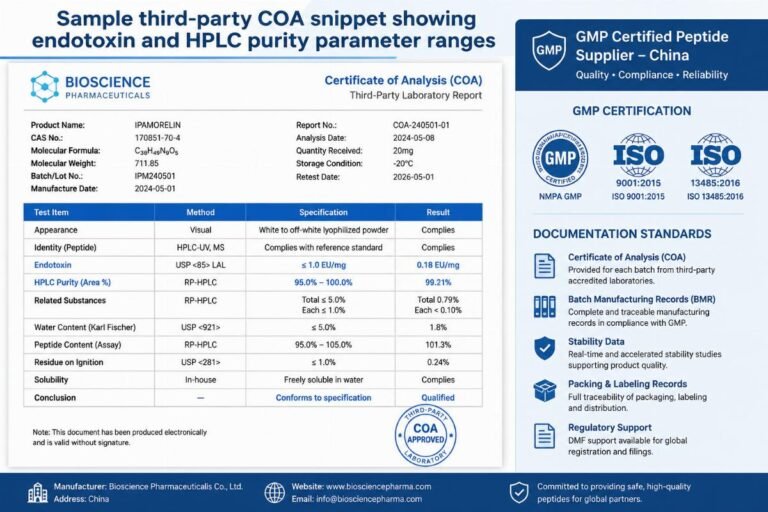
- Batch-Specific HPLC Chromatograms: These show the actual separation of impurities. Look for clear baseline resolution and integration reports.
- Mass Spectrometry (MS) Data: Confirms the molecular weight and sequence integrity.
- Residual Solvent Analysis: Critical for safety, especially if the synthesis involved organic solvents.
- Endotoxin Testing Results: Essential for any API intended for injectable formulations.
A common issue in the region is the submission of incomplete documentation to Ghana FDA. Customs officials may reject shipments if the CoA does not align perfectly with the import permit specifications. [NEED_CITE: Ghana FDA import requirements for pharmaceutical APIs]
I once reviewed a dossier where the CoA listed purity as "≥99%," but the attached chromatogram showed significant unidentified peaks. The supplier had edited the summary report but failed to update the raw data attachment. This discrepancy would have led to immediate rejection by a competent quality assurance team.
When you vet semaglutide API manufacturer Ghana options, demand the full data package. If a supplier hesitates to share raw chromatograms, consider it a red flag. Transparency is a hallmark of genuine cGMP operations.
How to Validate Cold-Chain Integrity Before Shipment?
Temperature excursions are the silent killer of peptide potency. In tropical regions, ambient temperatures can exceed recommended storage conditions within hours if packaging fails. [NEED_CITE: impact of temperature excursions on peptide stability]
Validation requires more than trusting the supplier’s word. It demands evidence of engineered solutions.
Steps to Validate Cold Chain:
- Request Packaging Validation Reports: Ask for data showing how their packaging performs under ISTA or similar standards. Specifically, look for tests simulating high-ambient temperatures.
- Require Real-Time Monitoring: Insist on the inclusion of USB or Bluetooth temperature loggers in every shipment. These devices record temperature at regular intervals, providing an immutable record of the cargo’s history.
- Check Phase-Change Material Specifications: Ensure the cooling agents used are rated for the expected transit duration plus a safety margin.
A case from a neighboring market illustrates the value of this approach. A buyer received a shipment with a logger showing a spike to thirty-five degrees Celsius for six hours. Because the data was available, they could quarantine the batch for testing rather than releasing it blindly. Subsequent analysis showed a noticeable drop in potency, saving them from a larger clinical failure.
Without this data, the same batch might have been released, leading to ineffective treatments and reputational damage. When you vet semaglutide API manufacturer Ghana partners, make real-time monitoring a non-negotiable requirement.
Which Regulatory Checks Prevent Ghana Customs Rejection?
Customs clearance in Ghana requires precise alignment between physical goods, documentation, and import permits. Discrepancies in HS codes or missing safety data sheets can cause delays that compromise product stability. [NEED_CITE: Ghana customs clearance procedures for pharmaceuticals]
Critical Regulatory Checks:
- HS Code Accuracy: Ensure the supplier uses the correct Harmonized System code for peptide APIs. Misclassification can lead to higher duties or seizure.
- MSDS Alignment: The Material Safety Data Sheet must match the CoA in terms of composition and hazard classification.
- Import Permit Verification: Confirm that the supplier’s documentation supports the specific conditions listed in your Ghana FDA import permit.
Many delays occur because suppliers provide generic MSDS documents that do not reflect the specific formulation or packaging of the batch. This inconsistency raises flags during inspection.
Additionally, verify that the supplier has experience with West African imports. Familiarity with local regulatory nuances can prevent simple errors that cause complex problems. For instance, some suppliers fail to include required legalizations or apostilles on certificates, leading to administrative rejections.
As you vet semaglutide API manufacturer Ghana choices, ask for references from other West African buyers. Their experience with local customs can provide valuable insights into potential pitfalls.
Conclusion
Verification is cheaper than replacement.
Importing Semaglutide API into Ghana requires a shift from price-based selection to risk-based verification. By demanding batch-specific data, validating cold-chain integrity, and ensuring regulatory alignment, buyers can secure a reliable supply of high-quality API. The cost of thorough vetting is negligible compared to the loss of a rejected shipment or compromised product quality. When you vet semaglutide API manufacturer Ghana candidates, prioritize transparency and technical competence over initial cost savings.
Leave a Reply