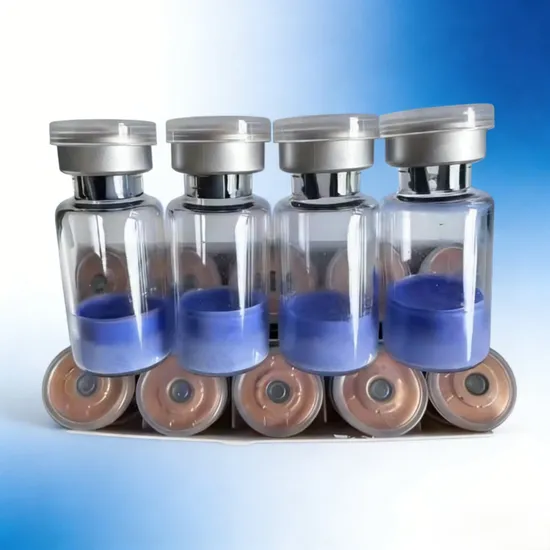
Method Transparency — Every batch certificate states the exact HPLC gradient, column, and wavelength used to establish the purity claim, so your laboratory can reproduce the result without guesswork.
Product Specification
| Parameter |
Value |
| Chemical Identity |
GHK-Cu Peptide, CAS 89030-95-5 |
| Product Type |
Peptide Raw Material |
| Appearance |
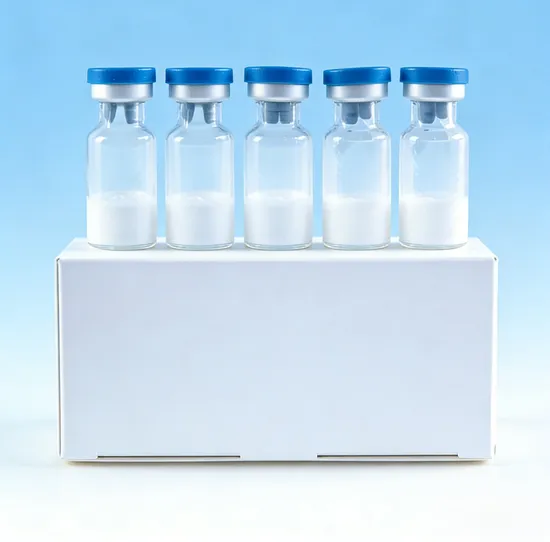
Lyophilized powder |
| Purity |
>99% by HPLC |
| Related Substances |
Impurity content below 0.1% (verified per batch) |
| Assay Methods |
HPLC, MS |
| Storage Temperature |
-20°C, sealed, light-protected |
| Packaging |
5 mg, 10 mg, 15 mg |
| MOQ |
5 mg |
| Certification |
COA, MSDS, HPLC report, MS report |
| Shelf Life |
24 months from date of manufacture (lyophilized powder at -20°C) |
| Standards Referenced |
USP, EP, GMP |
Intended Use
| Use Category |
Notes |
| Laboratory research input |
Supplied as lyophilized powder for in vitro analytical and research workflows |
| Cosmetic formulation raw material |
Compatible as an ingredient input for personal care formulation development |
| Analytical reference material |
Suitable for QC method development and instrument calibration verification |
Supplied as a raw material for research and manufacturing use. Not for human or veterinary use. Not a finished product.
Why Two Labs Report Different Purity on the Same GHK-Cu Peptide Batch
The discrepancy almost always traces back to unreported HPLC conditions, not to the material itself.
I worked on a case where a buyer received a GHK-Cu Peptide shipment with a CoA stating 99% purity, but their in-house HPLC returned a result 0.8 percentage points lower. After a month of back-and-forth, we discovered their gradient profile and detection wavelength differed from ours. Once both labs aligned on the same column chemistry and gradient slope, the numbers matched within 0.1%. This is a recurring issue across peptide raw materials: when the analytical method is not fully disclosed on the certificate, GHK-Cu Peptide purity HPLC analytical verification becomes impossible for the receiving lab to replicate. [NEED_CITE: HPLC method validation requirements per ICH guidelines]

How Named Analytical Methods Eliminate Purity Disputes
A certificate that reads "purity >99%" without specifying the column type, mobile phase composition, flow rate, gradient program, and detection wavelength leaves too many variables undefined. Our CoA for GHK-Cu Peptide documents every one of these parameters so your QC team can set up an identical method on their own instrument. This level of GHK-Cu Peptide purity HPLC analytical verification means the receiving laboratory has a concrete starting point rather than a trial-and-error process.
Mass Spectrometry as a Second Identity Check
HPLC confirms the purity profile, but it does not confirm molecular identity on its own. Each batch of GHK-Cu Peptide is therefore accompanied by an MS report showing the observed mass-to-charge ratio against the expected value for the copper complex of Glycyl-L-Histidyl-L-Lysine. When both orthogonal methods agree, your lab can proceed with confidence that the material matches both its stated identity and its stated purity. [NEED_CITE: orthogonal analytical testing requirements for peptide identity confirmation]
Reading the Specification Sheet Like a QC Manager
The stated purity of >99% by HPLC and impurity content below 0.1% are only meaningful when the analytical conditions are locked. For copper-complexed peptides like GHK-Cu Peptide, the choice of detection wavelength affects how individual impurity peaks are integrated; a shift of even a few nanometers can change the reported impurity profile. The lyophilized powder form also matters: any moisture uptake during storage or transit will alter the apparent peptide content on a weight basis, which is why the storage specification calls for -20°C sealed and light-protected conditions. Understanding these interactions between method, form, and storage is what separates a reliable certificate from a misleading one.
The Real Cost of a Certificate Without Method Detail
When a shipment arrives with incomplete analytical documentation, the consequences cascade through the procurement chain. A QC team that cannot reproduce the stated purity will flag the batch, triggering a deviation investigation that delays downstream work by weeks. If the receiving laboratory and the supplier are running different methods, neither side can prove the other wrong without a formal method transfer exercise — a process that costs time and resources far beyond the price of the material itself. For importers, incomplete documentation packages also mean customs holds, where every day of delay risks cold chain integrity for temperature-sensitive materials like lyophilized peptides. [NEED_CITE: cold chain packaging standards for temperature-sensitive materials]
Why Procurement Teams Source GHK-Cu Peptide Here
Every batch ships with a CoA that names the exact HPLC and MS methods used, removing the most common cause of lab-to-lab disagreement. Custom synthesis is available to your supplied sequence and modification, so non-catalogue variants can be produced with the same documentation standard. Research quantities starting at 5 mg and bulk scales come from the same production line, meaning scale-up does not introduce a new variable. Temperature-controlled packing includes transit temperature records, giving you documented proof that the cold chain was maintained. Import documentation is prepared according to destination requirements, reducing the risk of customs delays. Technical support on specification interpretation is available from staff with direct laboratory experience in HPLC and mass spectrometry.
Documentation & Traceability
- Batch-specific CoA stating the HPLC column, gradient, and wavelength used for this lot
- MS confirmation report showing observed mass for identity verification
- Analytical method summary formatted for direct transfer to your QC laboratory
- Retained sample from each production lot available for repeat testing
- Safety data sheet covering handling, storage, and transport classification
- Certificate of origin and import paperwork matched to destination country requirements
Storage, Handling & Shipping
- Store GHK-Cu Peptide lyophilized powder at -20°C in sealed, light-protected containers
- Aliquot upon reconstitution to avoid repeated freeze-thaw degradation cycles
- Reconstituted solutions remain stable approximately six months at -20°C
- Shipped in temperature-controlled packaging with a transit temperature data logger
- Cold chain logistics with documented temperature record available upon request
- Import documentation prepared per destination regulatory framework
What to Include in Your Inquiry
To help us match your analytical requirements, please specify the HPLC method your QC laboratory uses for peptide purity testing and whether you need method alignment support. Indicate your required packaging sizes, target quantity, and any specific import documentation your destination country demands. If you need retained samples or stability data for your quality system, note this at the inquiry stage so we can include it in the documentation package.
Frequently Asked Questions
Q: Which HPLC method is used to determine purity on the CoA?
A: Each batch of GHK-Cu Peptide is analyzed by HPLC with the column type, mobile phase, gradient program, flow rate, and detection wavelength recorded on the certificate. This allows your laboratory to reproduce the exact conditions. If your QC uses a different method, we provide an analytical method summary to support alignment between the two systems.
Q: What happens if our lab’s re-test result does not match the CoA?
A: We first compare the HPLC conditions side by side. Most discrepancies resolve once both labs run identical methods. If the gap persists, we can test a retained sample from the same batch and share the raw chromatograms. This structured approach isolates whether the difference comes from method variation or an actual batch deviation.
Q: Are retained samples available for repeat testing?
A: Yes. A retained sample from every production lot is kept under the same -20°C sealed, light-protected conditions specified on the CoA. If your laboratory needs a second vial for re-verification, we can dispatch it with a fresh temperature record to confirm that storage conditions have been maintained since the original release.
Q: How is the cold chain monitored during transit?
A: Every shipment of GHK-Cu Peptide is packed in temperature-controlled containers with an integrated data logger. The temperature record is available upon delivery, so you can verify that the -20°C requirement was not breached at any point. If the log shows an excursion, we replace the shipment and investigate the logistics failure.
Q: What import documents are provided with the shipment?
A: We supply a batch-specific certificate of analysis, safety data sheet, certificate of origin, and any additional paperwork required by your destination country. Documents are prepared before dispatch so that customs clearance can proceed without delay. Let us know your specific import requirements at the inquiry stage.