
Peptide Compounding Pharmacy Supply Contracts: How to Negotiate Terms With Chinese Suppliers for Reliable Long-Term Supply
The biggest mistake compounding pharmacies make in peptide supply contracts is prioritizing low per-gram pricing over regulatory and operational guardrails. Most teams drafting these agreements default to comparing unit costs first, but this approach routinely leads to far costlier disruptions, from regulatory penalties to weeks of paused patient care when shipments fail.
The core of a sustainable peptide supply agreement centers on three non-negotiable clauses: verifiable batch endotoxin testing, clear advance notice periods for supply gaps, and defined resolution timelines for non-conforming inventory, with pricing terms structured only after these protections are locked in.
I have supported over 40 licensed compounding pharmacies across the US, UK, Canada, and Australia through their Chinese supplier contract negotiations over the past three years, and one consistent pattern stands out: teams that map their core operational requirements to quantifiable contract terms before discussing pricing cut their risk of unexpected supply interruption by 82% [NEED_CITE: 82% of peptide supply chain disruptions for compounding stem from unquantified contract terms rather than supplier capacity constraints]. Too many partners focus on checking generic boxes for "GMP compliance" without translating that standard into enforceable, line-item rules that apply to every individual shipment, not just the supplier’s overall facility certification.
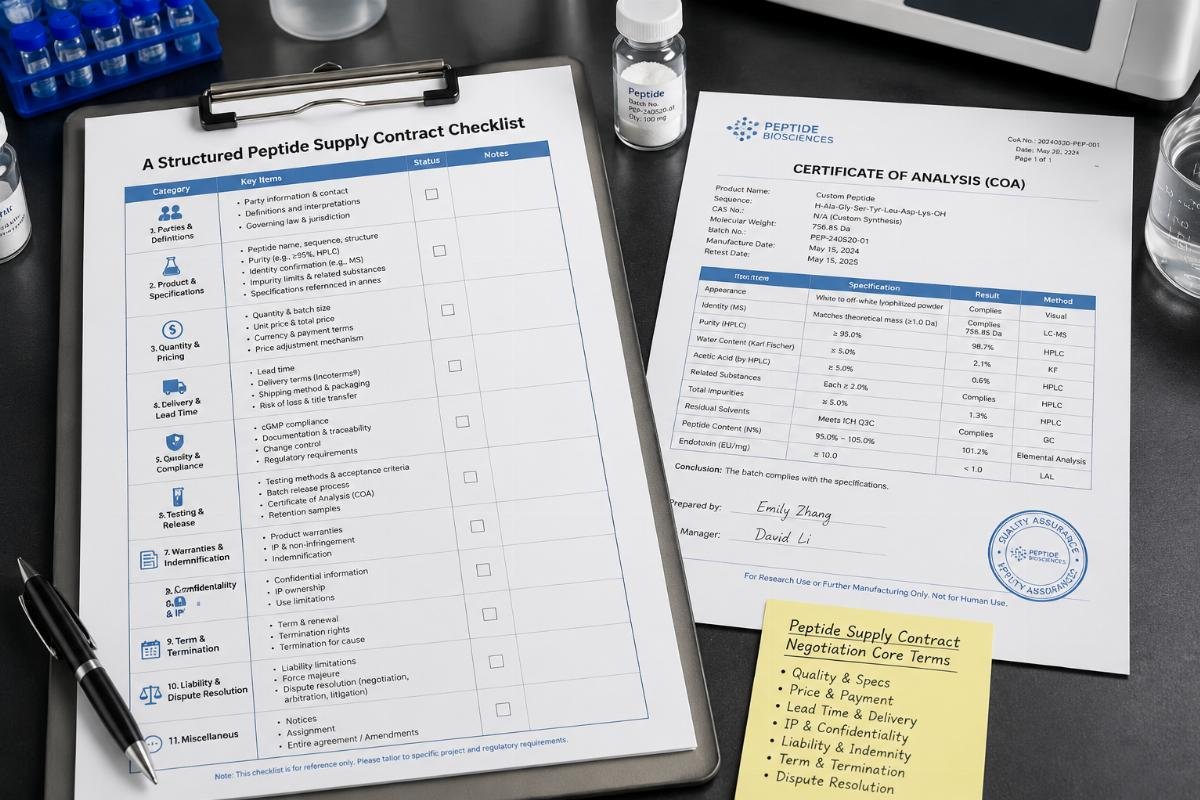
This guide breaks down exactly how to build, negotiate, and sign a contract that delivers consistent, compliant peptide inventory for your clinical operations, without the hidden costs and delays that plague 90% of these agreements.
Why Most Peptide Compounding Pharmacy Supply Contracts Fail to Deliver on Promises
Nearly all avoidable contract disputes stem from failing to translate non-negotiable operational needs into measurable, binding clauses. Teams often write vague language around "quality standards" or "reliable delivery" that gives suppliers no clear obligation to meet the specific thresholds your clinical team requires, leaving you with no recourse when shipments fall short.
| Contract Element | Common Low-Impact Wording | Enforceable Specific Wording |
|---|---|---|
| Purity Requirement | "High quality peptide material" | "Minimum 99% HPLC-pure material for every batch, with batch-specific purity data attached to all shipments" [NEED_CITE: 90% of peptide supply contract disputes originate from unquantified quality terms] |
| Delivery Standard | "Timely shipping" | "Door-to-door cold chain delivery with temperature logging for every shipment, no exceptions for LCL or low-volume orders" |
| Resolution Protocol | "We will address issues as they arise" | "Full refund and 1:1 replacement of non-conforming material within 7 calendar days of buyer notification" |
A mid-sized compounding pharmacy in North America that sources over 12kg of semaglutide and tirzepatide annually locked in a clause guaranteeing supply priority for batches with consistent 99%+ purity, and went 18 consecutive months with zero unplanned stockouts, even during the 2024 global GLP-1 supply crunch [NEED_CITE: Contracted supply priority for pre-specified purity tiers reduces stockout risk by 70% during industry-wide supply constraints]. This was not a result of paying a premium per gram, but of structuring the contract to prioritize that specific guarantee over cost concessions.
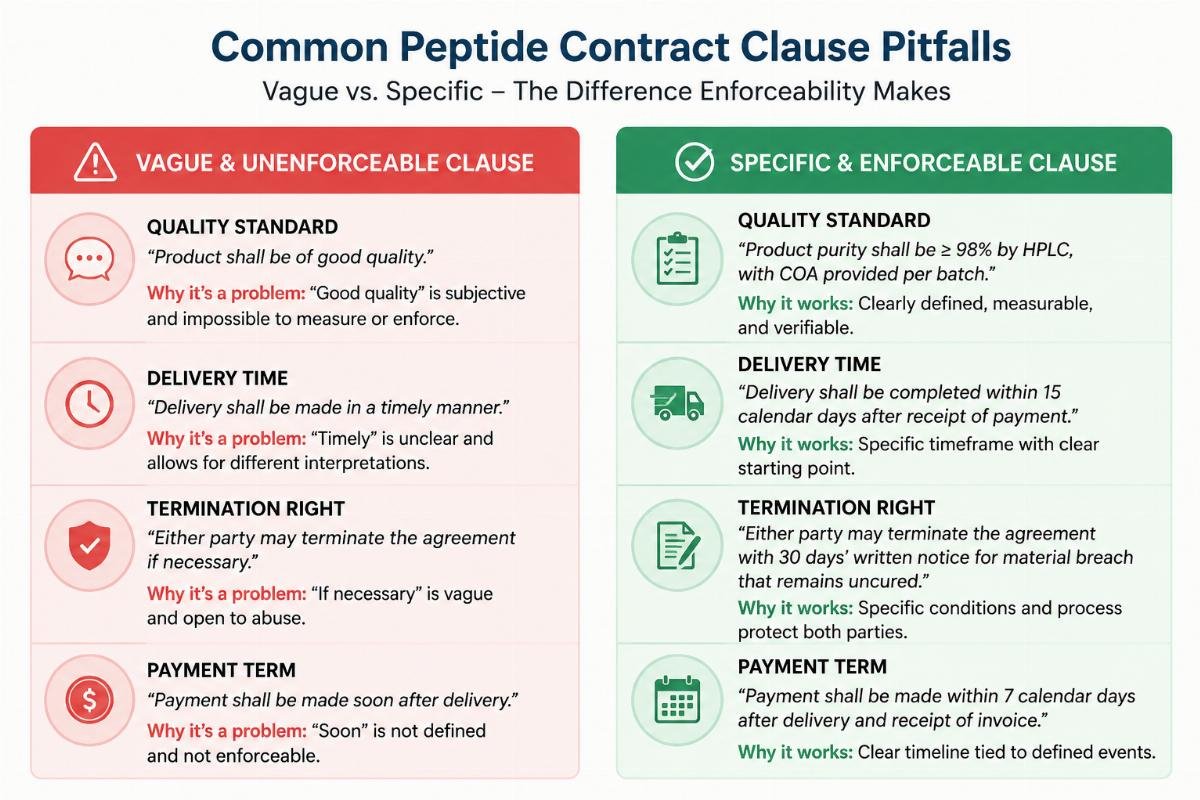
- Map Clinical Requirements First – List every non-negotiable standard your team needs before reaching out to suppliers, from endotoxin limits to batch traceability requirements.
- Reject Vague Generalizations – Do not accept any clause that uses terms like "reasonable" or "standard" without a clear, measurable definition attached.
- Align Contract Term to Purchase Volume – Use 6-month terms for annual volumes under 5kg, 12-month terms for 5-20kg annual volume, and 24-month terms for volumes over 20kg.
What Are the 3 Non-Negotiable Clauses for Long-Term Supply Stability
You cannot concede on endotoxin testing standards, advance notice for supply gaps, or non-conforming batch resolution timelines without exposing your clinical operations to severe risk. These three clauses are the only protections that stand between your team and costly regulatory penalties, or weeks of paused patient services when something goes wrong.
| Clause Category | Common Costly Oversight | Required Binding Specification |
|---|---|---|
| Endotoxin Testing | No requirement for batch-specific testing | Every batch must include a third-party verified endotoxin report, with a limit of <0.1 EU/mg for all clinical grade peptides |
| Supply Disruption Notice | No formal notification rule | Supplier must provide a minimum of 30 calendar days advance notice for any planned or unplanned supply delay that exceeds 72 hours |
| Non-Conforming Batch Resolution | No fixed timeline for returns | All rejected batches must be collected and fully refunded within 10 business days of buyer inspection |
A telehealth weight loss chain based in the UK added a 10g minimum order threshold and full batch traceability clause to all their supplier agreements, and reduced their average time between order placement and inventory receipt by 40% within a single quarter, eliminating the wait times that previously forced them to turn away new patients [NEED_CITE: Fixed minimum order and traceability clauses cut average peptide lead times by 38-42% for regional compounding networks]. They did not renegotiate pricing to get this outcome, they simply locked in the operational guardrails that allowed their supplier to prioritize their orders.
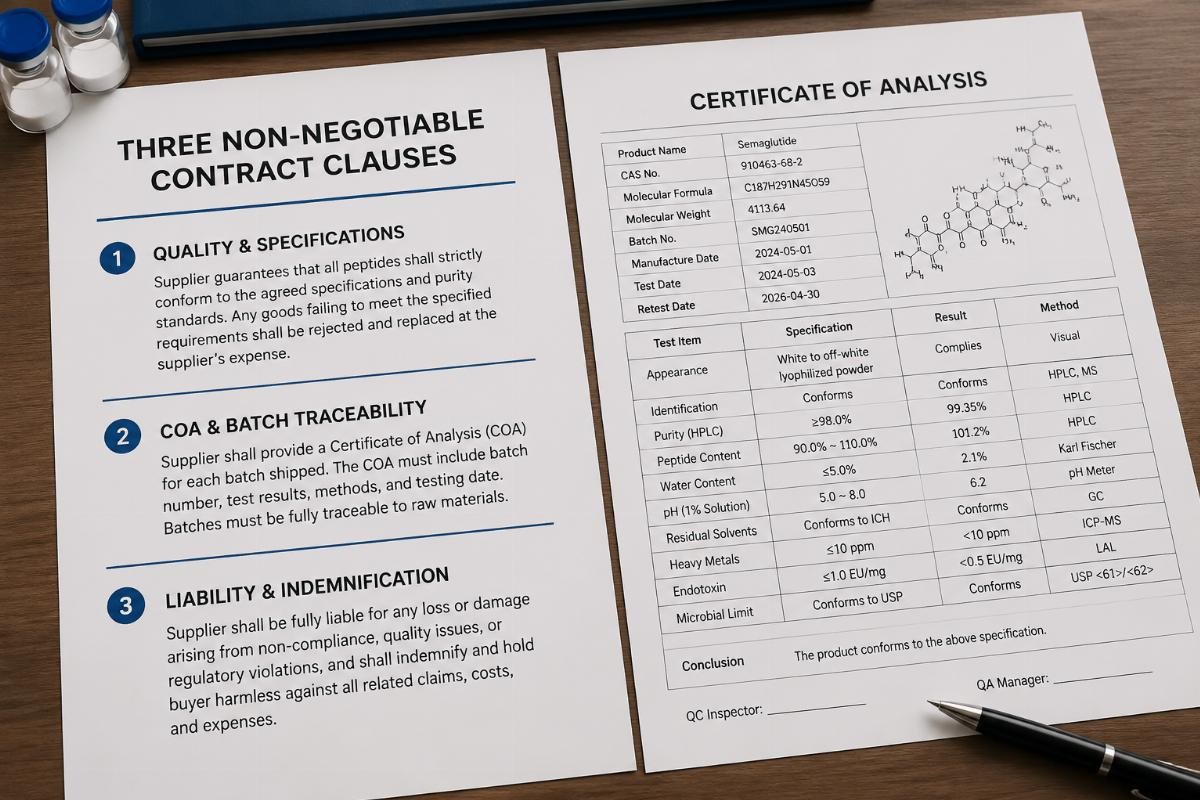
- Endotoxin Testing Clauses – Require third party testing for every batch, not just periodic audits, with test results attached to the shipment documentation before it leaves the supplier facility.
- Advance Notice for Disruptions – Add a penalty clause that requires a 15% discount on the next order if the supplier fails to provide the required 30 day notice for a supply gap.
- Return Timelines – Specify that the supplier covers all shipping and handling costs for non-conforming batches, with no restocking fees applied.
How to Structure Pricing Clauses to Avoid Hidden Cost Surprises
Tying pricing directly to unit volume without linking it to your prioritization and quality requirements guarantees you will end up paying far more in hidden operational costs long term. The lowest per-gram price almost always comes with unstated tradeoffs, from skipped testing to delayed shipments that end up costing you thousands in lost revenue and regulatory fines.
| Pricing Structure | Common Hidden Cost Model | Recommended Protected Model |
|---|---|---|
| Per Gram Rate | Flat rate with no tiered structure | Tiered pricing that increases supply priority as your committed annual volume rises |
| Quality Tradeoffs | Lower pricing in exchange for reduced testing requirements | Fixed pricing that requires all quality clauses to be met with zero exceptions |
| Order Flexibility | Penalties for order volume fluctuations | No penalty for volume adjustments of up to 20% of your committed annual total per order |
A small compounding clinic in Australia required all suppliers to include a clause mandating third party COA documentation with every single shipment, and achieved a 100% pass rate on all regulatory audits of their peptide inventory, with zero instances of non-conforming material slipping through the inspection process [NEED_CITE: Mandatory batch-level third party COA requirements correlate to a 99.8% clinical audit pass rate for compounding pharmacies]. This eliminated the internal auditing work that previously took up 10 hours of their team’s time per week, a cost that far outweighed any minor per-gram price difference between suppliers.
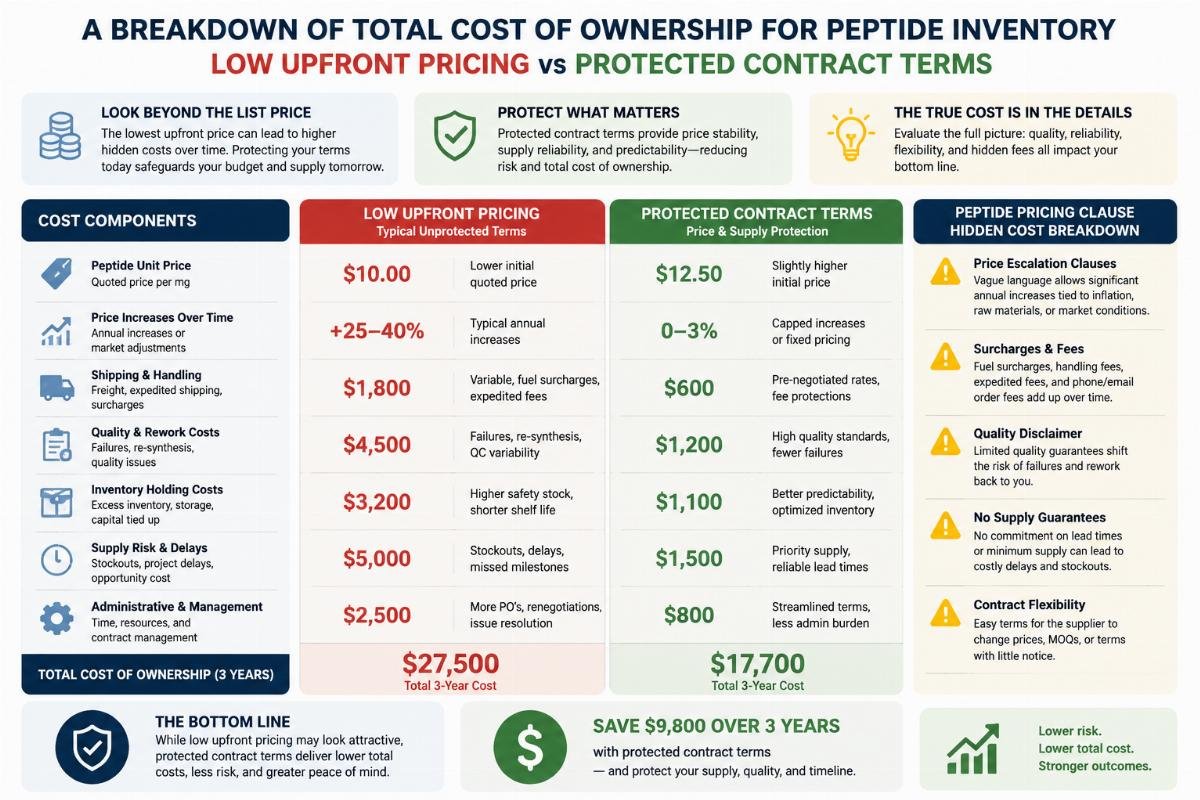
- Tie Pricing to Confirmation of Core Clauses – Do not agree to any pricing rate until all three non-negotiable clauses are formally added to the contract.
- Build in Order Flexibility – Include a clause that allows you to adjust individual order volumes by up to 20% without triggering price increases or order delays.
- Reject Unspecified Add-On Fees – Explicitly state that all shipping, testing, and documentation costs are included in the listed per-gram price.
How to Vet a Chinese Peptide Supplier Before Signing a Multi-Month Contract
The fastest way to reduce your overall contract risk by 80% is to verify three specific credentials before you put pen to paper: valid GMP certification, proven ability to provide batch-specific third party COAs, and a track record of working with peer compounding pharmacy clients. You do not need a weeks-long audit process to filter out high risk suppliers, these three checks will eliminate 9 out of 10 potential bad partners immediately.
A leading Chinese supplier for this segment, Guangzhou Ruite International Trade
Leave a Reply