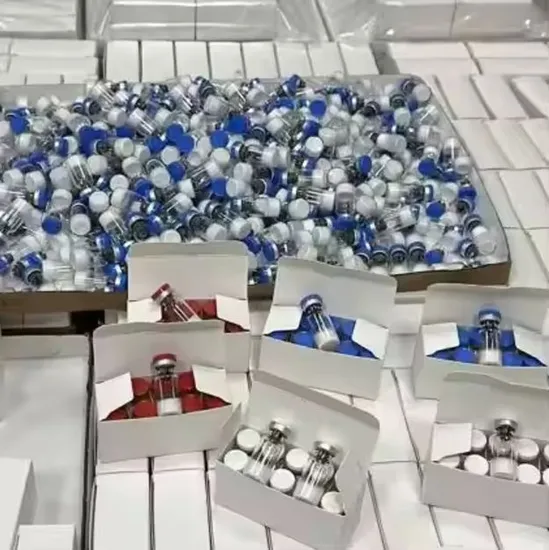
Transparent Method Alignment — every CoA for Ghk-Cu CAS 13012-55-8 explicitly names the HPLC, MS, and NMR protocols used, so your QC team can replicate the result without back-and-forth.
Product Specification
| Parameter |
Value |
| Chemical Identity |
Ghk-Cu, CAS 13012-55-8 |
| Product Type |
Peptide Raw Material |
| Appearance |
White lyophilized powder |
| Purity |
>99% (method to be confirmed; HPLC, MS, NMR available on request) |
| Format |
Lyophilized powder |
| Specification |
50 mg per container |
| Production Capacity |
10,000 g/year |
| Storage |
-20 °C, sealed, light-protected |
| Shelf Life |
24 months from manufacturing date at -20 °C |
| Reconstitution Stability |
Approximately 1 month at 4 °C; approximately 6 months at -20 °C |
| Reconstitution Solvent |
Sterile water or buffer, 1–10 mg/mL |
| Assay Methods |
HPLC, MS, NMR (available upon request) |
| Quality Standards |
GMP, ISO 9001 |
Intended Use
| Use Category |
Notes |
| Laboratory research input |
Suitable for in vitro assay development and cell culture studies |
| Cosmetic formulation raw material |
Compatible with aqueous and buffer-based formulation systems |
| Analytical reference |
Usable as a benchmark material for HPLC and MS method validation |
| Synthesis intermediate |
Applicable as a starting material for further peptide conjugation work |
Supplied as a raw material for research and manufacturing use. Not for human or veterinary use. Not a finished product.
Why Purity Claims Without Named Methods Undermine Your QC Workflow
A purity figure is only as defensible as the analytical method behind it.
When a certificate states a percentage without naming the HPLC column, mobile phase pH, or detection wavelength, your laboratory has no baseline for reproducing the result. I have seen this mismatch cause weeks of back-and-forth between buyer and supplier QC teams, particularly when the receiving lab uses a different buffer system and obtains a divergent chromatogram. With Ghk-Cu CAS 13012-55-8 analytical verification purity HPLC reporting, the exact method parameters are documented so both sides work from the same reference point. [NEED_CITE: HPLC method validation requirements per ICH guidelines]
Method-Transparent Certificate of Analysis
Each batch of Ghk-Cu ships with a certificate that lists the specific HPLC conditions, MS ionization mode, and NMR solvent used for that lot. This means your analytical team receives the same method summary our QC laboratory followed, enabling direct protocol alignment rather than guesswork. The Ghk-Cu CAS 13012-55-8 analytical verification purity HPLC data is traceable to the individual container you receive.
Batch Traceability and Retained Sample Protocol
Every production lot is assigned a unique identifier linking the CoA, mass spectra, and chromatographic data to a retained sample stored under the same -20 °C conditions. If your laboratory observes a discrepancy during incoming inspection, we can retrieve the retained sample and run a side-by-side comparison using your specified method. This traceability chain ensures that disputes are resolved through data rather than negotiation. [NEED_CITE: retained sample requirements under GMP quality systems]
How Specification Details Affect Downstream Work
The lyophilized powder form of Ghk-Cu requires reconstitution before use in any analytical or formulation workflow, and the choice of solvent directly affects solubility and stability. Reconstituting in sterile water or buffer at 1–10 mg/mL yields a solution stable for approximately one month at 4 °C, while aliquoting and storing at -20 °C extends stability to roughly six months. The white appearance of the powder serves as a quick visual check: any discoloration upon receipt may indicate moisture ingress or temperature excursion during transit. Storage at -20 °C in sealed, light-protected containers is critical because copper-peptide complexes are susceptible to oxidative degradation when exposed to ambient humidity and light over prolonged periods. The 50 mg specification suits research-scale screening; laboratories requiring larger campaigns should confirm bulk availability against the stated 10,000 g/year production capacity. Method alignment between supplier and buyer QC is especially important here — differing mobile phase pH values in HPLC can shift the apparent purity by a measurable margin, which is why our CoA names the exact conditions used.

The Hidden Cost of Incomplete Documentation at Customs
When import paperwork does not match the destination country’s requirements, shipments sit in bonded warehouses accumulating storage fees while your project timeline stalls. Incomplete safety data sheets, missing certificates of origin, or CoA documents that lack method details can each trigger a hold. For temperature-sensitive materials like lyophilized Ghk-Cu, the absence of a cold-chain packing record gives customs inspectors grounds to question whether the material remained within specification during transit. [NEED_CITE: cold chain packaging standards for temperature-sensitive materials]
Why Procurement Teams Source Ghk-Cu Here
Batch-specific certificates name the exact HPLC, MS, and NMR methods used, so your QC lab can replicate the analysis without requesting additional information after delivery. Custom synthesis is available if your project requires a modified sequence or a scale beyond the standard 50 mg specification, with feasibility review before commitment. Research and bulk quantities come from the same production line, eliminating the need to re-validate when you scale from milligram trials to gram-level campaigns. Temperature-controlled packing with transit temperature records accompanies every shipment, providing documented evidence that the -20 °C storage requirement was maintained. Import documentation is prepared according to the destination market’s regulatory framework, reducing the risk of customs delays. Technical support on specification alignment, handling protocols, and storage conditions is available after delivery to help your team resolve any analytical discrepancies.
Documentation & Traceability
- Batch-specific CoA stating HPLC column type, mobile phase composition, and detection wavelength for this Ghk-Cu lot
- Mass spectrometry confirmation report verifying molecular identity of CAS 13012-55-8
- NMR spectral data available upon request using the order number for lot traceability
- Safety data sheet covering handling, PPE requirements, and transport classification for lyophilized peptide powder
- Certificate of origin prepared per destination country import requirements
- Cold-chain packing record documenting temperature conditions throughout transit
Storage, Handling & Shipping
- Store Ghk-Cu at -20 °C in the original sealed container to maintain the 24-month shelf life
- Protect the white lyophilized powder from light exposure to prevent photo-oxidative degradation
- Limit freeze-thaw cycles of reconstituted solutions; aliquot into single-use volumes before freezing at -20 °C
- Reconstituted solutions remain stable for approximately one month at 4 °C in sealed vessels
- Shipments are packed with temperature-controlled materials and include a transit temperature record
- All containers are sealed and labeled with batch number, CAS 13012-55-8, and storage instructions
Request a Specification Review
To initiate an inquiry, provide the target quantity, required assay methods, and any specific documentation your import regulations demand. If your laboratory uses a particular HPLC protocol for incoming verification, share the method parameters so we can confirm alignment before dispatch. For projects requiring scale-up beyond research quantities, include the timeline and any modified specification requirements so our team can assess feasibility.
Frequently Asked Questions
Q: How is peptide purity verified, and which analytical methods are named on the CoA?
A: Each batch of Ghk-Cu CAS 13012-55-8 is tested using HPLC, MS, and NMR as applicable. The certificate of analysis explicitly names the column type, mobile phase conditions, and detection parameters used, enabling your QC laboratory to reproduce the method and verify the reported specification independently.
Q: Can I request detailed HPLC, MS, and NMR spectra for my specific batch?
A: Yes. Detailed spectral data and chromatograms are available upon request using your order number. We provide the raw data files so your analytical team can overlay them with in-house results and confirm peak assignments against the Ghk-Cu reference standard.
Q: How do you handle cases where the buyer’s QC re-test result differs from the CoA?
A: We retrieve the retained sample from the same lot and run a parallel analysis using your laboratory’s specified method. If the discrepancy stems from method differences such as mobile phase pH, we document the findings and work with your QC team to reach a mutually accepted protocol.
Q: What are the storage conditions and documented shelf life for lyophilized Ghk-Cu?
A: The lyophilized powder is stored at -20 °C in sealed, light-protected containers with a documented shelf life of 24 months from the manufacturing date. Reconstituted solutions are stable for approximately one month at 4 °C or up to six months when aliquoted and stored at -20 °C.
Q: What documentation is included with each shipment for import and customs clearance?
A: Every shipment includes a batch-specific CoA with named analytical methods, a safety data sheet, certificate of origin, and cold-chain packing record. Additional import documents are prepared according to the destination market’s requirements and included in the shipping package.